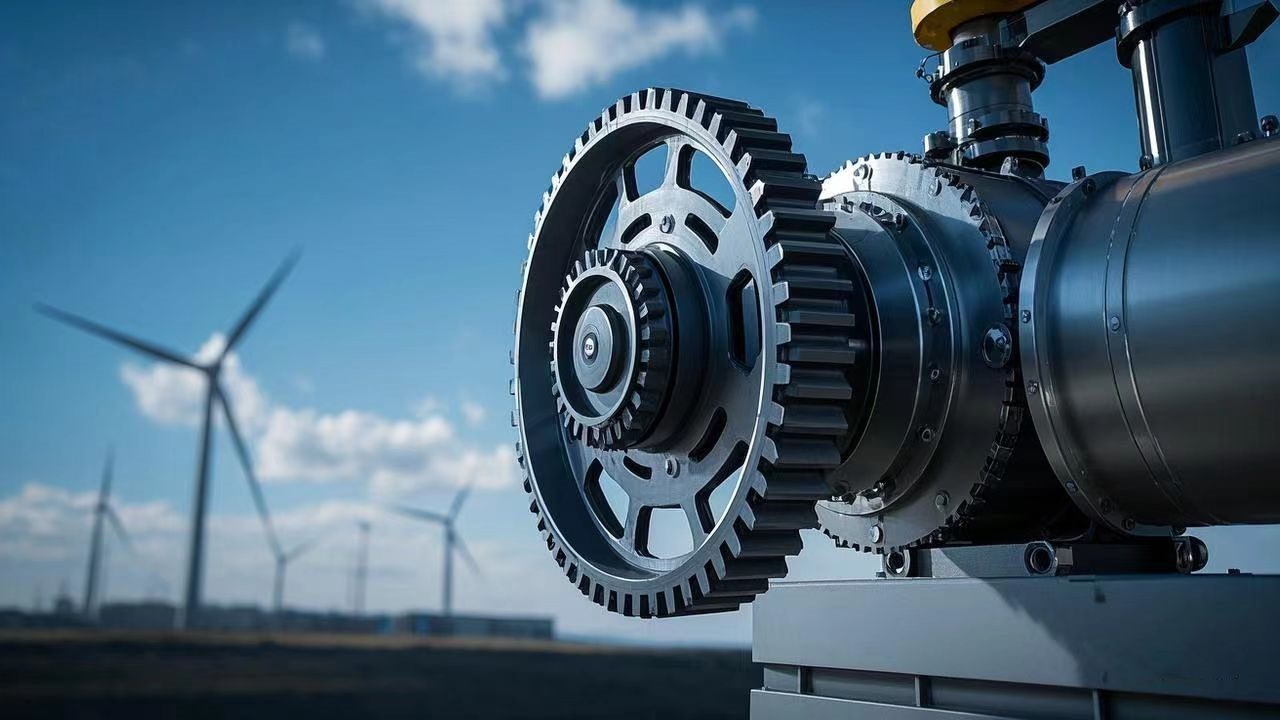
In the wind power industry, forgings such as wind turbine main shafts, gearbox internal parts, and bearing assemblies often operate under the most severe conditions. Therefore, the steel selected directly determines whether the wind power equipment can reach its design life or suffer costly premature failure.
As a chromium-nickel-molybdenum alloy steel, 34CrNiMo6 steel is supplied in the quenched and tempered (+QT) condition, possessing both high tensile strength, deep hardenability, and excellent low-temperature toughness. These properties make it the preferred material for large wind turbine components, especially in the 5 to 10 MW power range.
What is 34CrNiMo6 Steel?
34CrNiMo6, material number 1.6582, is a medium-carbon chromium-nickel-molybdenum alloy steel, conforming to the European standard EN 10083-3.
According to the naming rules of EN10027, the “34” in 34CrNiMo6 indicates that the steel has an average carbon content of 0.34%. The “6” represents the average chromium and nickel content, both being 6/4 = 1.5%. This steel also contains molybdenum, but the specific content is not mentioned.
Chemical Composition
| Grade | C | Mn | P | S | Si | Cr | Ni | Mo |
| 34CrNiMo6/1.6582 | 0.30-0.38 | 0.50-0.80 | ≤0.025 | ≤0.035 | ≤0.4 | 1.3-1.7 | 1.3-1.7 | 0.15-0.3 |
Heat Treatment Basics
Mechanical Property
| Tensile Strength | Yield Strength | Elongation | Reduction of Area | Impact Charpy-V | Hardness |
| 950-1100 Mpa | 750-900Mpa | ≥12% | ≥45% | ≥50J | 28-34HRC |
34CrNiMo6 Steel:Four Core Advantages in Wind Power Applications
Deep Through-Hardening for Large Sections
The combined effect of Cr, Ni, and Mo gives 34CrNiMo6 significantly better hardenability than 42CrMo4.For shafts with diameters exceeding 100 mm (typical dimensions for megawatt-class wind turbines),42CrMo4 typically cannot achieve a complete martensitic transformation in the core, leading to reduced center hardness and decreased fatigue performance.
34CrNiMo6 maintains stable mechanical properties up to 250 mm in diameter, making it suitable for large-diameter forgings used in modern turbines.
High Fatigue Resistance
Wind turbine shafts are subject to rotating bending and torsional fatigue over an estimated 10^9 cycles during a 20-year design life.
The fatigue limit of 34CrNiMo6 steel in the quenched and tempered state is approximately 550 MPa. A clean, fine-grained microstructure obtained through appropriate forging and heat treatment processes minimizes fatigue crack initiation points.
Excellent Low-Temperature Toughness
The nickel content (1.30%–1.70%) lowers the ductile-brittle transition temperature, ensuring reliable impact performance even at temperatures as low as -40°C.
This is crucial for wind power equipment located at high altitudes where winter temperatures often drop below freezing. Brittle fracture is one of the most severe failure modes of wind turbine shafts, and the addition of nickel provides a significant safety margin.
Resistance to Temper Embrittlement
Large forgings cool slowly during heat treatment and may remain within the temper embrittlement temperature range (350–500 °C) for extended periods.
Adding molybdenum to 34CrNiMo6 steel can suppress this phenomenon, maintaining intergranular toughness even after prolonged heat treatment.This is particularly important for large-diameter shafts where cooling rates are inherently slow.
34CrNiMo6 Steel:Four Applications in Wind Power
34CrNiMo6 is used across several critical wind turbine components. The selection depends on component size, load magnitude, and turbine power rating.
Main Shafts
The main shaft transmits rotor torque to the gearbox. It withstands a combination of bending, torsional, and axial loads.For turbines in the 5–10 MW range, main shaft diameters typically exceed 200 mm, and 34CrNiMo6 is specified to ensure adequate through-section strength and fatigue resistance.
34CrNiMo6 main shafts are typically forged integrally with an integral flange, followed by quenching, tempering, and finishing.
Gearbox Input and Output Shafts
Gearbox shafts, especially the high-speed output shafts that connect to generators, operate under high cyclic loads and require precise bearing journal surfaces.
34CrNiMo6 steel possesses the required strength and fatigue resistance,while induction hardening of bearing journals achieves 50–55 HRC surface hardness for wear resistance.This steel is also used in planetary carrier shafts in multi-stage gearboxes.
Gears and Pinions
While case-carburizing grades such as 18CrNiMo7-6 are often preferred for gear teeth requiring very high surface hardness, 34CrNiMo6 is used for through-hardened gears and pinions in medium-load stages.
After QT, 34CrNiMo6 steel achieves 300–360 HB, which can be further surface-hardened by induction or nitriding for improved flank wear resistance.
Bearing Seats and Flanges
Large bearing rings, yaw bearing components, and rotor hub flanges may use 34CrNiMo6 when the component size exceeds the hardenability capability of 42CrMo4. The grade’s through-hardening ensures uniform mechanical properties across the full ring cross-section.
Wind Power Components:34CrNiMo6 vs Alternative Grade
The following table compares 34CrNiMo6 against the most common alternative grades used in wind turbine shaft and gear applications.
When selecting a steel grade, cross-sectional dimensions, required strength, operating temperature, and total cost should be considered, rather than solely relying on tensile strength.
| Property / Feature | 34CrNiMo6 (1.6582) | 42CrMo4 (1.7225) | 18CrNiMo7-6 (1.6587) | 30CrNiMo8 (1.6580) |
| C(%) | 0.30–0.38 | 0.38–0.45 | 0.15–0.21 | 0.26–0.34 |
| Ni (%) | 1.3-1.7 | ≤ 0.40 | 1.50–1.80 | 1.80–2.20 |
| Cr (%) | 1.3-1.7 | 0.90–1.20 | 1.50–1.80 | 1.80–2.20 |
| Mo (%) | 0.15–0.30 | 0.15–0.30 | 0.25–0.35 | 0.30–0.50 |
| Relative Cost | Medium-High | Low-Medium | High | High |
| Tensile Strength,Mpa | 900–1100 | 800–1000 | 1100–1300 (core) | 1000–1200 |
| Hardenability | High | Medium | Very High | Very High |
| Low-Temp Toughness | Excellent | Good | Excellent | Excellent |
| Fatigue Limit,Mpa | 550 | 450 | 600+ (case) | 580 |
| Surface Treatment | Induction / Nitriding | Induction / Nitriding | Carburizing | Induction / Nitriding |
| Typical Wind Use | Main shafts, gearbox shafts 5–10MW | Shafts ≤5MW, medium components | High-load gears, pinions | Very large shafts >10MW |
Frequently Asked Questions
Get a Technical Quote for 34CrNiMo6 Wind Power Components
√ ISO 9001 Certified √ MTR Included √ Global Shipping √ Custom Cutting √ Technical Support
Related Wind Power Steel By FUHONG
SAE 4340 Steel Bar | AISI 4340 Alloy Steel-ASTM A29


34CrNiMo6 Steel Round Bars With Full Size In Stock
1000+tons Full Size Stock For 4340 Steel Bright Bars

EN24+QT Steel | 817M40 | 34CrNiMo6 Round steel

30CrNiMo8 Alloy Steel | DIN 1.6580-EN10250

34CrNiMo6 Steel Bar | DIN 1.6582 Alloy Steel