
Air-hardened cold-working tool steel has become the first choice for many mold manufacturing companies due to its advantages of high hardness and small deformation after quenching in air.As representatives of American standards, A2 and A8 have won the trust of engineers and manufacturers with their excellent performance.
Although they belong to the same category, they have their own unique performance characteristics in different application scenarios. This article will make a comprehensive comparison from the aspects of chemical composition, heat treatment process to performance, and finally provide a professional reference for mold material selection.
Chemical Composition: A2 Steel vs A8 Steel
| Grade | C | Si | Mn | Cr | Mo | V | W |
| A2 | 0.95-1.05 | 0.1-0.5 | 0.4-1.0 | 4.75-5.5 | 0.9-1.4 | 0.15-0.5 | / |
| A8 | 0.5-0.6 | 0.75-1.1 | 0.2-0.5 | 4.75-5.5 | 1.15-1.65 | / | 1.0-1.5 |
A2 and A8 steel belongs to the same category of Air-quenched cold working tool steel.However, the two have different focuses in terms of performance, which can be seen from their chemical composition.
- A2 steel:Wear resistance first, toughness second. Higher carbon content, better wear resistance, but slightly lower toughness than A8 steel.
- A8 steel:Toughness first, wear resistance second. Lower carbon content, but higher molybdenum and Tungsten content, providing excellent toughness and impact resistance, wear resistance slightly inferior to A2 steel.
Heat Treatment Composition: A2 Steel vs A8 Steel
| A2 steel | A8 steel | |
| Quenching temperature | 940-970°C | 950-1010°C |
| Tempering temperature | 175-540°C | 175-540°C |
| Typical hardness | 58-62 HRC | 56-60 HRC |
Similar heat treatment processes, both of A2 and A8 steel can achieve high hardness.
The difference in tempering temperature will cause differences in the final performance.
- A2 steel:The reason for choosing A2 is its wear resistance, which requires a tempering temperature of 180-220°C.It should be noted that the toughness is often at its lowest at this temperature.
- A8 steel:A8 usually has better hardenability and has a stronger secondary hardening effect (hardness may increase after high temperature tempering) due to the higher alloying elements.If wear resistance is required, a tempering temperature of 180-220°C is recommended. For a better balance of strength and toughness, a tempering temperature of 400-540°C can be chosen.
Performance Composition:A2 Steel vs A8 Steel
Performance Advantages
| A2 steel | 1. Excellent wear resistance 2. Good toughness 3. Small air quenching deformation 4. Moderate compressive strength 5. Average high temperature stability (<400°C) |
| A8 steel | 1. Excellent toughness & impact resistance 2. Good wear resistance (but usually slightly lower than A2 of the same hardness) 3. Small air quenching deformation 4. High compressive strength 5. Slightly better high temperature stability than A2 |
Core Differences
- A2 steel: Wear resistance is its biggest advantage, and toughness is enough for most cold working applications.
- A8 steel: Toughness and impact resistance are its biggest advantages. Although wear resistance is good, it is usually slightly inferior to A2 of the same hardness. A8 has higher compressive strength and can withstand greater forming pressure.
How to Choose A2 Steel and A8 Steel?
1. Prioritize wear resistance, moderate impact load? -> A2 steel is usually a more cost-effective choice.
2. Molds subject to extremely high impact loads, high stress, easy to crack? -> A8 steel is a better choice, its excellent toughness can prevent early failure.
3. Need high compressive strength (such as heavy forming)? -> A8 steel is better.
4. Workpiece shape is complex, thin-walled, and stress concentration is severe? -> A8 steel has a more obvious toughness advantage.
5. Budget-sensitive and working conditions are not extreme impact? -> A2 steel is often more cost-effective.
6. Replace brittle steels such as D2 to solve cracking problems? -> A8 steel is a common toughness upgrade solution (sacrifice a little wear resistance in exchange for high toughness).
Both A2 and A8 are excellent air-quenched die steels. A2 is a wear-resistant “standard” choice for a wide range of applications that require good wear resistance and moderate toughness. A8 is a toughness-oriented “upgrade” choice, designed to handle the most severe impact, high stress and cracking conditions while still maintaining good wear resistance.
Which one to choose depends on the trade-off between wear resistance, toughness, compressive strength and cost in your specific application. In situations where extremely high toughness is required, A8 is often an ideal alternative material to solve the problems of D2 or A2 die chipping and cracking.
RELATED COLD WORK STEEL PRODUCTS BY FUHONG STEEL
DIN 1.2358 Tool Steel | 60CrMoV18-5
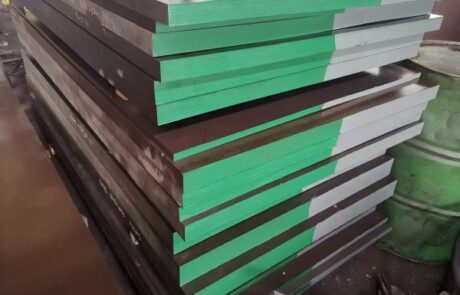
A2 Air Hardening Tool Steel | DIN 1.2363
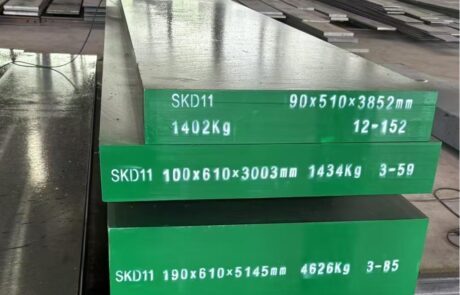
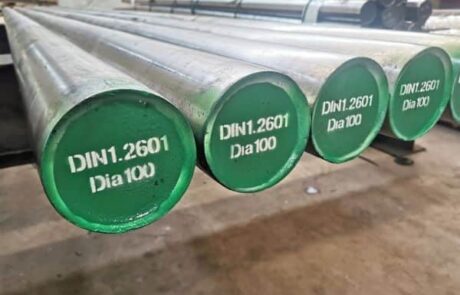
DIN 1.2601 | X165CrMoV12-DIN 17350 Standard

DIN 1.2510 Tool Steel | 100MnCrW4 | AISI O1 | SKS3

DIN 1.2080 Tool Steel | X210Cr12 | AISI D3 | SKD1

DIN 1.2767 Tool Steel | X45NiCrMo4-DIN 17350

DIN 1.2842 Tool Steel | 90MnCrV8 | AISI O2