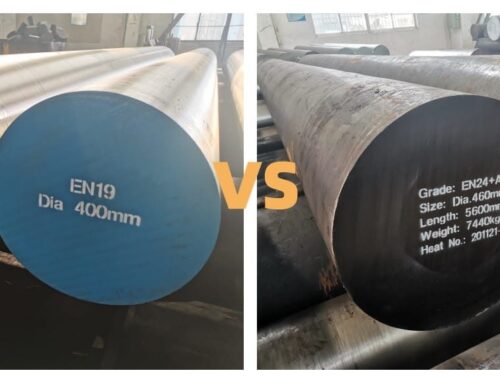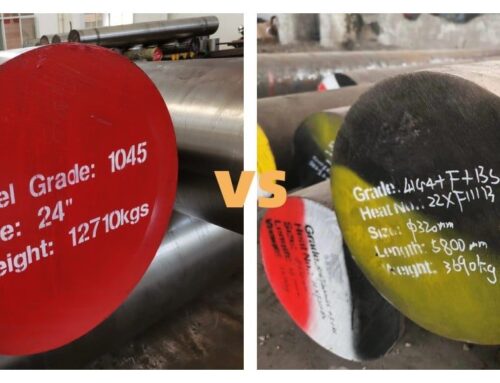

1045, C45, and S45C are the same medium-carbon steel family under three different standards — AISI/SAE (US), EN/DIN (Europe), and JIS (Japan). They are interchangeable for most general engineering purposes. The real differences lie in impurity limits (P/S), residual element controls, and carbon range tightness, which affect machinability, toughness, and consistency.
The following is a comprehensive comparative analysis of 1045, C45 and S45C steels, covering key aspects such as chemical composition, mechanical properties, application areas, heat treatment characteristics and standard differences.
International Standards & Equivalent Grades
These three grades are often listed side-by-side in suppliers’ datasheets because they essentially describe the same material: non-alloy structural steel with a carbon content of 0.45%. They come from different standards bodies and have slightly different ranges of chemical composition control.
| Grade | Standard | Alternative name | Primary Region |
| 1045 | ASTM A29 | SAE 1045,AISI 1045 | United States |
| C45 | EN 10083-2 | C45E,CK45,1.0503 | Europe / Germany |
| S45C | JIS G4051 | S45 | Japan |
These three types of steel are all medium-carbon non-alloy steels, suitable for quenching and tempering (Q&T) processes. They achieve a good balance in strength, ductility, and machinability, earning them the reputation of “general-purpose structural steels.”
Chemical Composition Comparison
| Elements (%) | 1045 | C45 | S45C |
| Carbon (C) | 0.43-0.5 | 0.42-0.5 | 0.42-0.48 |
| Silicon (Si) | ≤0.4 | ≤0.4 | 0.15-0.35 |
| Manganese (Mn) | 0.6-0.9 | 0.5-0.8 | 0.6-0.9 |
| Phosphorus (P) | ≤0.04 | ≤0.045 | ≤0.03 |
| Sulfur (S) | ≤0.05 | ≤0.045 | ≤0.035 |
First,these three types of steel have similar carbon content, but S45C has a narrower carbon content range, which means that its quenching response is the most stable.
Secondly, 1045 and S45C have higher manganese content, which means they have slightly better hardenability.
In addition, S45C has the most stringent control over phosphorus and sulfur impurities, resulting in high purity, excellent toughness, and good fatigue resistance.
Comprehensive Performance Comparison
As-Supplied / Annealed Condition
| Properties | 1045 | C45 | S45C |
| Tensile strength (MPa) | ~585 | ≥ 600 | ≥ 570 |
| Yield strength (MPa) | ~450 | ≥355 | ≥345 |
| Elongation (%) | ≥16 | ≥14 | ≥17 |
| Hardness (HB) | 170-210 | 163-210 | 160-220 |
Quenched and Tempered (Q&T) Condition
After water quenching at 820–870 °C and tempering at 500–600 °C, all three grades of steel achieved similar strength-toughness ranges.
| Properties | 1045 | C45 | S45C |
| Tensile strength (MPa) | 700 – 850 | 700 – 850 | 690 – 850 |
| Yield strength (MPa) | 500 – 650 | 500 – 650 | 490 – 650 |
| Elongation (%) | 14 – 18 | 12 – 16 | 14 – 18 |
| Hardness (HRC) | 25 – 32 | 25 – 32 | 25 – 32 |
It should be noted that the quenching and tempering performance is related to the cross-sectional size. For cross-sections with a diameter ≤16 mm, the yield strength can exceed 500 MPa; for cross-sections of 41–100 mm, due to limited hardenability, the yield strength will drop to about 370 MPa.
Hardenability Depth-End Quench Test
| Materials | Critical diameter to 50% martensite (oil quenching) | End quenching curve characteristics (Jominy distance vs hardness) |
| 1045 | 20–25 mm | Faster hardness drop, about HRC 45 at J=10mm |
| C45 | 22–28 mm | Similar to 1045, but European process may optimize quenching medium |
| S45C | 30–35 mm | Slower hardness decay, still maintains HRC 40+ at J=15mm |
S45C has a higher upper limit for manganese content (0.9%) and stricter impurity control, resulting in significantly better hardenability than the other two steels. Therefore, it is more suitable for parts with larger cross-sections. 1045 and C45, on the other hand, are more suitable for small shafts or parts that do not require full hardening.
Dynamic Performance : Fatigue & Impact Toughness-Quenched & Tempered
| Materials | Fatigue limit (10⁷ cycles) | Impact toughness |
| 1045 | 240–270 MPa | 40–50 J |
| C45 | 260–290 MPa | 45–55 J |
| S45C | 280–320 MPa | 50–60 J |
S45C has stricter control over harmful impurities such as sulfur and phosphorus, so its fatigue limit and impact strength are also superior under the same conditions.
Comparison:Heat Treatment Response
All three grades of steel are treated with the same heat treatment process. The critical hardening diameter in water is approximately 12–17 mm, meaning that sections thicker than approximately 20 mm cannot be fully hardened, resulting in a softer core.
| Process | Temperature | Cooling | Hardness |
| Full Annealing | 790 – 840 °C | Furnace cool | 150 – 170 HB |
| Normalizing | 820 – 870 °C | Still air | 180 – 210 HB |
| Quenching | 820 – 870 °C | Water (thin) / Oil (complex) | Up to 60 HRC |
| Tempering | 500 – 650 °C | Air / water | 25 – 32 HRC |
| Induction / Flame Hardening | Surface only | Water spray | 54 – 60 HRC |
It’s important to note that water quenching may cause cracks in complex geometries or thick sections. Oil quenching can reduce the risk of deformation, but it may not achieve full hardness for sections thicker than approximately 12 mm.
Comparison: Processing Performance
Machinability
- Annealed condition:50-55%
- Cold drawn / normalized condition:60-65%
Weldability
All three grades are considered fair to poor in weldability due to their medium carbon content. Welding is possible but requires precautions:
- Preheat to 150–300 °C, especially for sections thicker than 6 mm
- Use low-hydrogen electrodes (E7018 or equivalent)
- Perform post-weld heat treatment (PWHT) at 550–650 °C to relieve stress
Cold Forming
All three types of steel have moderate cold forming properties. In the annealed state, they can undergo moderate cold heading or bending, but are not suitable for drastic cold forming. For cold-forged parts, low-carbon steel (1018/S20C) is more suitable.
Typical Applications
All three product grades are suitable for the same application areas. The choice of which one to use typically depends on the regional supply chain and the specific performance trade-offs mentioned above.
Common applications for all three:
- Shafts and spindles
- Gears and sprockets
- Bolts, studs, and nuts (high-strength)
- Pins, axles, and connecting rods
- Crankshafts and camshafts
- Tool holders and die holders
- Hydraulic clamps and cylinders
- General machinery structural parts
Market supply chain selection
1045:General mechanical parts such as shafts, gears, connecting rods, bolts, etc. (North American market).
C45:Transmission parts, hydraulic cylinders, tool chucks, etc. in the European machinery manufacturing industry.
S45C:High-precision parts in the Japanese and Asian markets, such as mold inserts, precision gears, and automotive steering parts.
Can they be substituted for each other?
Yes, in most cases.
For general structural components, shafts, gears, and fasteners operating under normal conditions, these three materials can be substituted for each other without the need for redesign. The mechanical properties after heat treatment overlap almost completely.
However, the following situations require careful consideration when substitution
1.Fatigue-critical or impact-loaded parts: Prefer S45C (or C45E with low S/P) over standard 1045. The lower impurity content measurably improves fatigue life and Charpy impact values.
2. For mass production: 1045 steel is preferred. Its higher sulfur content reduces tool wear and machining cycles. If S45C steel is used, tool costs are expected to be slightly higher.
3.Welded assemblies: All three require the same precautions. No grade is meaningfully easier to weld than the others.
4. Thick sections requiring overall hardening: None of these three types of steel are suitable for sections thicker than approximately 50 mm. Regardless of the initial steel grade, it is recommended to upgrade to alloy steel (4140 / 42CrMo4 / SCM440).
5.Certification / traceability requirements: C45 under EN 10083 provides the most detailed chemical certification including residual element reporting. If your customer requires EN compliance, use C45.
6.Surface hardness via induction: All three achieve 54–60 HRC surface hardness. S45C’s tighter carbon range gives more consistent case depth from batch to batch.
1045, C45, and S45C are three names for the same workhorse steel. For 80% of applications, the choice is driven by regional availability and existing drawing standards, not by performance differences.
When an application pushes a performance to its limits, such as manufacturability, toughness, or certification traceability, then the subtle differences in components between standards become meaningful, and the selection guide above will point you to the right grade.
Related Carbon Steel Products By Fuhong Steel

S235JR Cold Drawn Flat Bars For Construction Joints Use

SAE 1020 Carbon Steel | AISI 1020 Steel Bar

DIN 1.1730 Tool Steel | C45W-DIN 17350 Standard
SAE 1045 Steel Bar | AISI 1045 Carbon Steel-ASTM A29

C50 Carbon Steel | CK50 | AISI 1050

C40 Carbon Steel | CK40 | DIN 1.0511

C35 Carbon Steel | CK35 | DIN 1.0501

CK45 Carbon Steel | DIN 1.1191-SEW550

28Mn6 Quality Special Steel | DIN 1.1170 | 150M28