
Question: 4140 and 4145 look almost identical in the datasheet, how do I choose?
To answer this question, we will comprehensively compare the two in key aspects such as chemical composition, mechanical properties, applications, and processing characteristics.
Chemical Composition Comparison
| Elements (%) | 4140 Steel | 4145 Steel |
| Carbon (C) | 0.38-0.43% | 0.43-0.48% |
| Chromium (Cr) | 0.80-1.10% | 0.80-1.10% |
| Molybdenum (Mo) | 0.15-0.25% | 0.15-0.25% |
| Manganese (Mn) | 0.75-1.00% | 0.75-1.00% |
| Silicon (Si) | 0.15-0.35% | 0.15-0.35% |
4140 and 4145 belong to the same alloy family. The “41” prefix indicates chromium-molybdenum steel, and the last two digits indicate the nominal carbon content in percent. The target carbon content of 4140 is approximately 0.40%, and the target carbon content of 4145 is approximately 0.45%. Removing the label, their alloying elements are essentially the same.
Mechanical Properties Comparison
| Properties | 4140 Steel | 4145 Steel |
| Tensile strength (MPa) | 850-1000 | 900-1100 |
| Yield strength (MPa) | 650-800 | 750-900 |
| Elongation (%) | 15-20 | 12-18 |
| Hardness (HRC) | 28-32 | 30-35 |
| Impact toughness | Higher (low carbon, good toughness) | Slightly lower (high carbon, slightly weaker toughness) |
Carbon is the primary determinant of the hardness of quenched and tempered steel. Increasing carbon content leads to increased strength, but a slight decrease in toughness. At the same hardness, higher strength almost always means lower elongation and reduction of area.
With the same quenching and tempering process, 4145 steel has slightly higher hardness and strength, but its elongation and reduction of area are also slightly lower.
If the component is subjected to impact, vibration, or fatigue, a slight loss of toughness is more important than the additional tens of megapascals of strength, in which case 4145 is not the preferred choice. However, if the component is subjected to continuous loads and wear, then the higher-strength 4145 steel is the preferred option.
Comparison:Machining & Heat Treatment & Welding & Hardenability
How machinable are 4140 and 4145 steel?
Both 4140 and 4145 steels have good machinability in the annealed state. However, in the quenched and tempered state, the high-carbon 4145 steel has a relatively higher hardness, which increases the difficulty of machining it.
Which is more difficult to weld, 4140 or 4145 steel?
Higher carbon in 4145 raises the carbon-equivalent,which in turn increases the difficulty of welding.
Both require preheating (150-300°C) and post-weld tempering. Neither is difficult to weld, but 4145 steel has a lower tolerance for error, making the welding process more stringent.
How is the quenching and tempering process for 4140 and 4145 steel?
The quenching processes for both are exactly the same, with oil quenching at 850-870°C, and they can be carried out in the same furnace.
The difference lies in the tempering process. To maximize the strength of 4145 steel, a lower tempering temperature is used. If a balance of strength and toughness is required for 4145 steel, the tempering temperature is increased. The same procedure applies to 4140 steel.
What are the hardenability of 4140 and 4145 steel?
Higher carbon in 4145 raises the hardenability, so 4145 reaches a given hardness deeper into a bar than 4140 would at the same quench.On thin sections the difference is hard to feel,but on heavy shafts and forgings it can decide whether the core actually meets specifications.
How to Choose Between 4140 and 4145 steel?
Choose 4140 steel in the following situations:
1.Parts requiring toughness, fatigue resistance, and medium to high strength to withstand dynamic or torsional loads.
2.For smaller cross-sectional dimensions, 4140 steel can achieve the target hardness through integral hardening.
3.Machining costs and availability are critical.You need a well-established grade with proven heat treatment processes.
Typical applications:
- Automotive parts-crankshafts, drive shafts, gears
- Mechanical parts-connecting rods, molds, tool holders
- Applications that require comprehensive strength, wear resistance and toughness.
Choose 4145 steel in the following situations:
1.The component is subjected to continuous high static loads, contact stress, or wear.
2.Due to its large cross-sectional dimensions, 4140 steel cannot achieve the required hardness. Deep hardenability is crucial.
Typical applications:
- Oil drilling equipment-drill pipes, drill bits, downhole tools
- Highly stressed parts of heavy machinery-hydraulic pistons, high-strength bolts
- Tools that require higher surface hardness and wear resistance.
For the vast majority of shafts, gears, pins, and fasteners, 4140 is a reasonable default choice because it is readily available and offers the best balance of toughness. When the cross-section is large and the load is primarily static wear load, 4145 should be selected.
Related 4140 & 4145 Steel Products By Fuhong
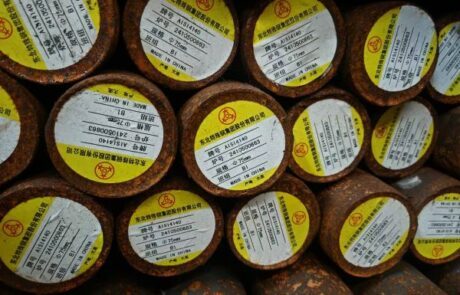
3000+ tons Inventory For 4140 Hot Rolled Round Steel Bar
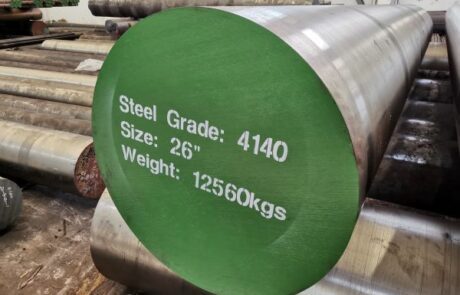
SAE 4140 Steel Bar | AISI 4140 Alloy Steel-ASTM A29
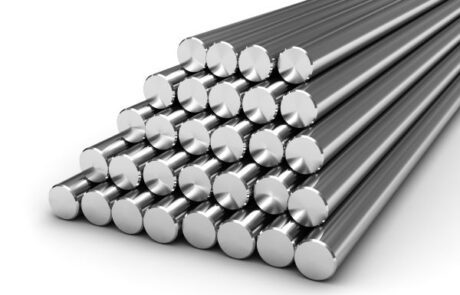
One-Stop Solution For 4140 Steel Bright Bar
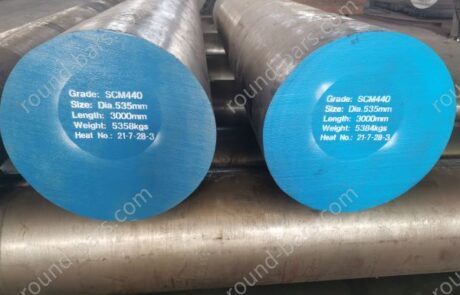
SCM440 | SCM430 Alloy Steel-JIS G4105


EN 42CrMo4 Steel |42CrMoS4| DIN1.7225