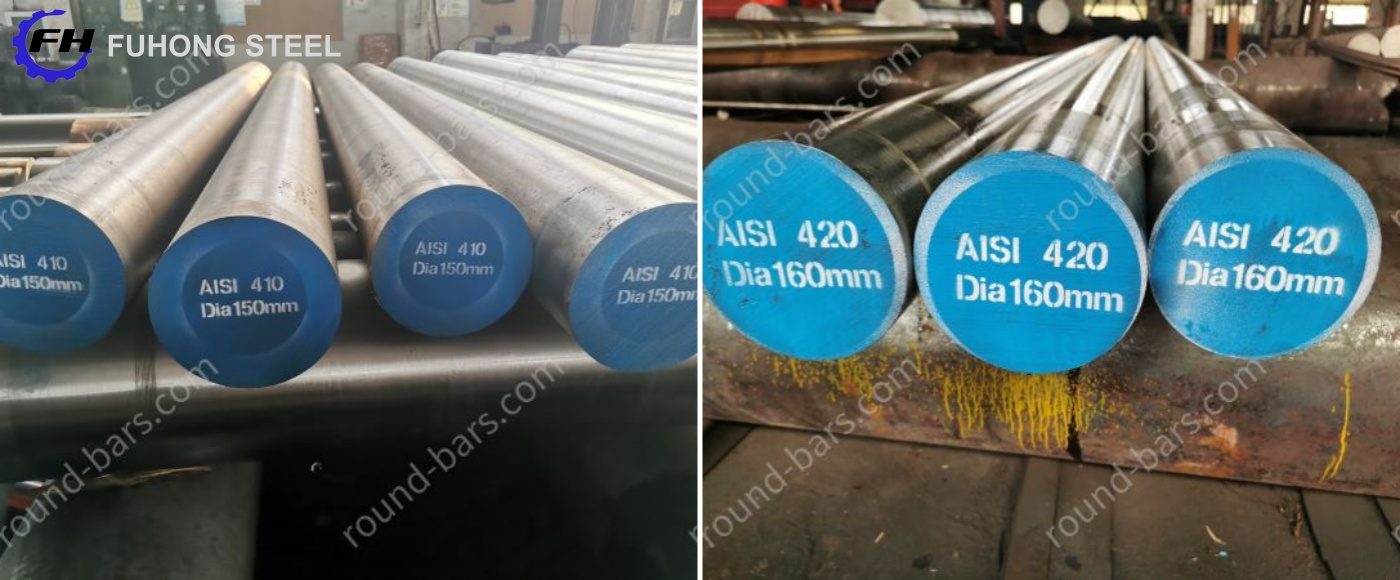
As martensitic stainless steels, 410 and 420 share many basic properties, but in key performance areas, 410 steel leans towards toughness and machinability, while 420 steel leans towards hardness and wear resistance. How to choose? Which is better?
This article will provide a detailed comparison from the perspectives of chemical composition, core properties, processing technology, and application, offering clear guidance for material selection and application in related fields.
Chemical Composition:410 Steel vs 420 Steel
| Grade | C | Si | Mn | Cr |
| 410 | 0.08-0.15 | ≤1.0 | ≤1.0 | 11.5-13.5 |
| 420 | ≥0.15 | ≤1.0 | ≤1.0 | 12.0-14.0 |
The core difference between 410 steel and 420 steel is the carbon content.The carbon content of 420 is significantly higher than that of 410, which allows 420 to achieve higher hardness and wear resistance through heat treatment (quenching + tempering), but at the same time reduces its toughness and weldability.
Key Performance:410 Steel vs 420 Steel
- Corrosion resistance:Both 410 and 420 steels have moderate corrosion resistance. Neither is suitable for highly corrosive environments, and their corrosion resistance is roughly the same.
- Hardness and Wear resistance:After quenching and tempering, the hardness of 420 steel can reach HRC 50-55, which is higher than that of 410 steel (HRC 40-45). At the same time, 420 steel has better wear resistance.
- Toughness:Conversely, 420 steel has lower toughness than 410 steel.
- Weldability:Both 410 and 420 steels have generally poor weldability and require strict adherence to welding procedures. However, 410 steel is slightly better in this regard.
- Machinability:410 steel has better machinability than 420 steel.
Heat Treatment Process:410 Steel vs 420 Steel
| Process | AISI 410 | AISI 420 |
| Annealing | 860-900℃/Furnace cooling | 860-900℃/Furnace cooling |
| Quenching | 950-1050°C/oil | 980-1040°C/oil |
| Tempering | 200-750°C | 150-250°C |
Both 410 and 420 steels can have their properties adjusted through heat treatment.The difference is that 410 has a wider tempering range, which can meet different performance requirements, while 420 can only ensure high hardness through low-temperature tempering.
Typical Application:410 Steel vs 420 Steel
410 Steel-Balanced overall performance (strength, toughness, corrosion resistance)
with moderate carbon content, a balance between strength and toughness, good machinability and weldability, suitable for industrial structural components requiring comprehensive performance.
Typical Application:
- General-purpose corrosion-resistant structural components: valves, pump parts, fasteners, shafts
- Turbine blades, boiler components (medium-temperature environment)
- Cutlery, low-load knives
- Offshore oil platform equipment (requiring certain corrosion resistance and strength)
420 Steel-Pursuing high hardness and wear resistance, with non-extreme requirements for corrosion resistance.
with a high-carbon formula, outstanding hardness after heat treatment, and excellent wear resistance, suitable for “hardcore” applications such as cutting tools and precision parts.
Typical Application:
- High-hardness, wear-resistant parts: surgical instruments, scalpels, razor blades, cutting blades
- Plastic molds (require polishing and moderate corrosion resistance)
- Bearings, measuring tools
- High-end kitchenware (such as high-end dinner knives)
X20Cr13 and X30Cr13, Which One to Choose?
If good overall performance, corrosion resistance, and machinability are prioritized, 410 steel is a cost-effective choice.
If extremely high hardness, wear resistance, and maintaining sharp edges are required, 420 steel is clearly a more suitable choice.
Related Stainless Steel Products By FUHONG
AISI 304 Stainless Steel | DIN 1.4301
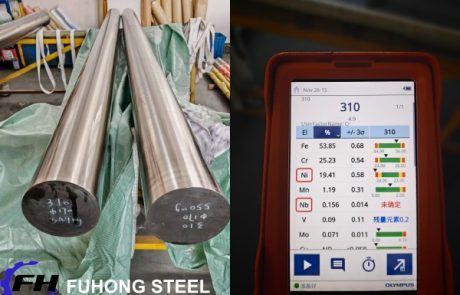
AISI 310 | 310S Stainless Steel | DIN 1.4841
DIN 1.2316 Tool Steel | X36CrMo17-DIN 17350 Standard
AISI 440C Stainless Steel | X105CrMo17 | DIN1.4125 | SUS440C


AISI 410 Stainless Steel | X12Cr13 | DIN 1.4006 | SUS410