Most gear failures are unpredictable. Gearbox gears may run for years and then suddenly fail, seemingly out of bad luck: teeth shear off, bearing surfaces wear down, shafts break under unexpected impacts.
To reduce the occurrence of such failures, designers, through continuous experimentation, ultimately chose 8620 steel.
8620 is not a magic steel. It is a low-carbon nickel-chromium-molybdenum alloy that requires a heat treatment process called carburizing to achieve both surface hardness and internal toughness.Most steels struggle to achieve this simultaneously, but 8620 steel does.
This article will explore the advantages of 8620 steel and its superior performance in five application areas.
What is Actually 8620 Steel?
8620,a low-carbon alloy steel, around 0.20% carbon, with nickel, chromium, and molybdenum added in small amounts. The AISI/SAE composition range looks like this:
| Grade | C | Si | Mn | P | S | Cr | Ni | Mo |
| 8620 | 0.18-0.23 | 0.15-0.35 | 0.70-0.90 | ≤0.035 | ≤0.04 | 0.4-0.6 | 0.4-0.7 | 0.15-0.25 |
It’s necessary to clarify what 8620 is not.It is not an integrally hardened steel like 4140 steel,nor is it stainless steel with significant corrosion resistance.Its key characteristic lies in its carburizing process:machine the part first, harden the surface later.
Because 8620 has a very wide range of applications, most national standard systems have corresponding steel grades: UNS G86200, DIN 1.6523 / 21NiCrMo2, JIS SNCM220, and GB 20CrNiMo. This makes it easy to find in most markets.
What Does Carburizing Do?
Low carbon is key, which may sound contradictory. Gear teeth need to be wear-resistant, which typically means high carbon and high hardness. But it also needs a core capable of absorbing impact without cracking. A high carbon content throughout would satisfy the former but compromise the latter.
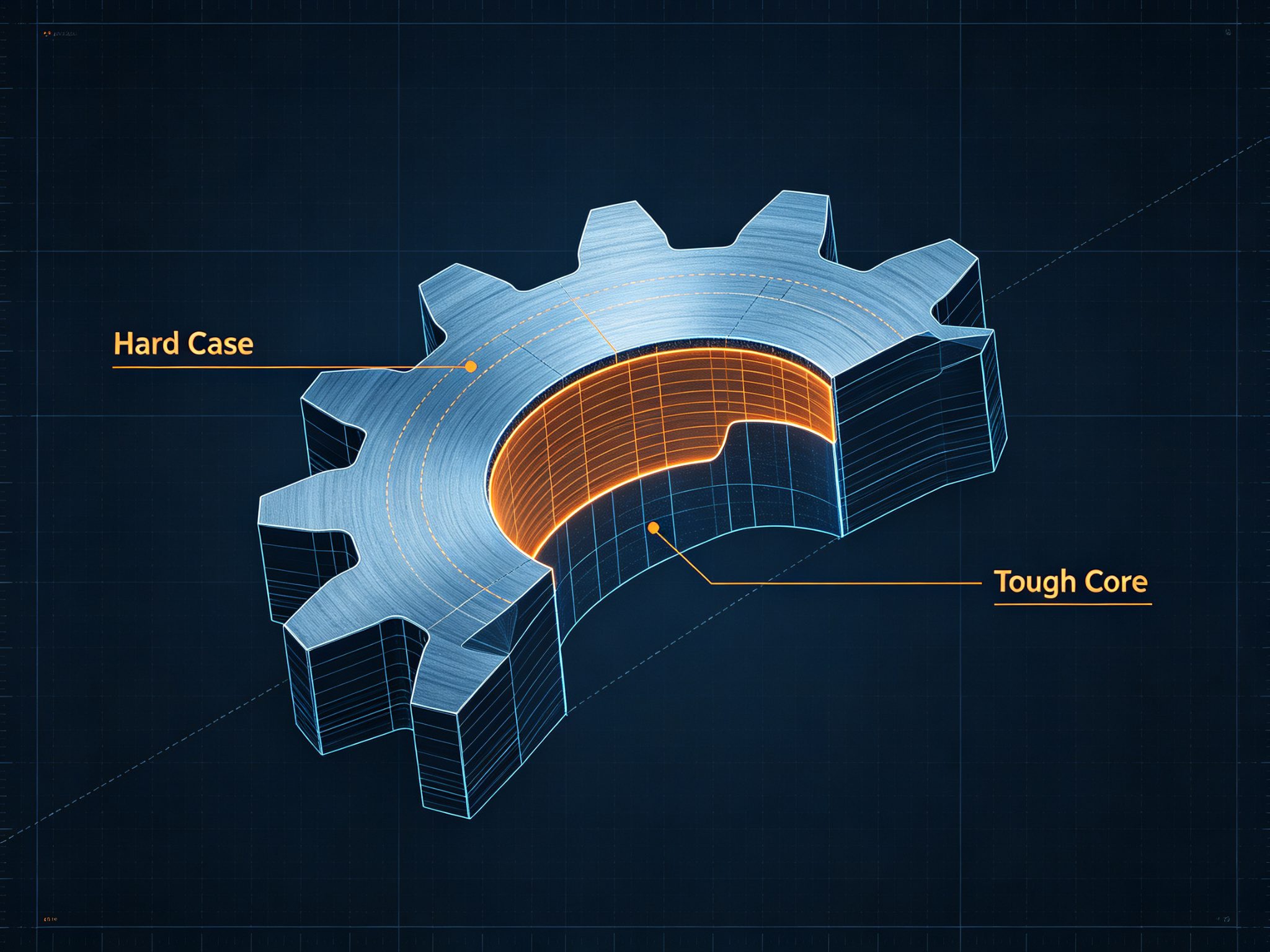
Carburizing achieves both. The part is machined in a softened annealed state and then heated in a carbon-rich atmosphere at approximately 870–925 °C. Carbon diffuses to the surface layer. After quenching and tempering, this layer transforms into hard martensite, while the low-carbon core remains relatively soft and tough.
This results in the steel’s renowned combination of properties: a surface hardness of approximately 58–62 HRC, while the core material maintains good ductility and impact resistance. Wear primarily occurs on the surface,impact loads are absorbed by the core material.
8620 Steel: Five Key Characteristics
These characteristics, taken individually, are not extreme. Their value lies in their combined use, which is quite valuable.
| Characteristic | What it means in practice |
| Hard case, typically 58–62 HRC after carburizing | Surface resists wear and contact fatigue |
| Tough, ductile core | Absorbs impact and shock without cracking |
| Good machinability before hardening | Complex shapes can be machined first, then cased |
| Stable, well-understood heat treatment | Case depth and distortion stay predictable with proper process control |
| Global availability and equivalents | Easy to source and cross-reference across standards |
8620 Steel:Five Core Applications
1. Gears and Gearbox components
This is where 8620 steel excels: automotive transmission gears, differential gears and pinions, as well as industrial gear sets. Gear teeth bend under load, and contact surfaces wear. A hardened outer layer resists wear,a tough core withstands bending and impact at the tooth root. Few steels can achieve both of these requirements at a comparable cost.
2. Shafts and Camshafts
Camshafts, cam followers, and medium-duty shafts run against other surfaces and take twisting and shock loads.Journals require a hardened surface to withstand long-term use, and shafts need a certain degree of bending resistance to prevent breakage. Carburized 8620 steel meets both requirements, making it widely used in general-purpose shafts for engine valve mechanisms and powertrain systems.
3. Pins and Fasteners
King pins, pivot pins, wrist pins, and other fasteners requiring hardening: These parts bear concentrated loads and sliding contact, sometimes with poor lubrication. Hardening prevents scuffing and wear,the tough core material prevents shearing under impact.
4. Bearing races and bushings
8620 steel is ideal for applications where rolling or sliding surfaces need to withstand wear without breaking. Bearing raceways and bushings exhibit excellent wear resistance in critical areas while maintaining sufficient toughness to withstand misalignment, edge loads, and impacts.
5. General machinery and powertrain hardware
Beyond powertrain systems, this steel grade covers a wide range of components: couplings, chain pins, rocker arms, off-highway and agricultural machinery parts, and internal gearbox components in a variety of applications, from construction machinery to wind turbines. Whether the application requires “surface wear, core impact resistance,” 8620 steel is a reliable choice.
How to Judge Whether 8620 is The Right Grade?
When selecting new parts, you can quickly screen for the following:
1. Will the surface of the part wear during use? If so, a hard surface treatment is required.
2. Will it be subjected to impact, vibration, or bending? If so, a strong core is crucial.
3. Can you machine it before hardening? If yes, 8620’s soft-state machinability is an advantage.
4. Is the required case depth moderate? If yes, the grade fits. If you need a thick, deep case or very high core strength, look elsewhere.
If most answers are yes,then 8620 is a wise choice.Not because it’s the best steel at anything, but because it combines two properties that usually fight each other, and does it at a cost and consistency that are hard to argue with.
That’s the real reason it keeps showing up in the same places: gears, shafts, pins, bearing races, and the general machinery around them. There’s only one requirement: external wear resistance and internal impact resistance, and 8620 reliably meets this requirement.
Related Carburizing Steel Product By FUHONG


18CrNiMo7-6 | DIN 1.6587 Case Hardening Steel-EN10084

16MnCr5 Steel | DIN 1.7131 Case Hardening Steel


EN36 Case Hardening Steel | AISI 3310 | 15NiCr13


DIN 15CrNi6 | 1.5919 Case Hardening Steel-DIN 17210