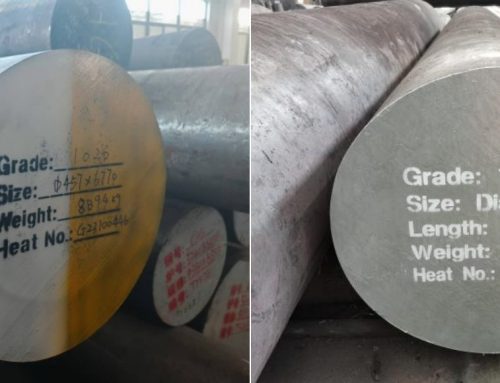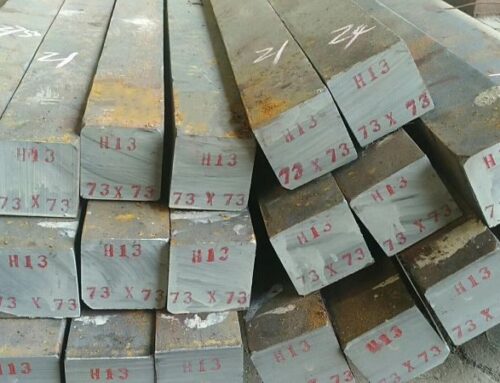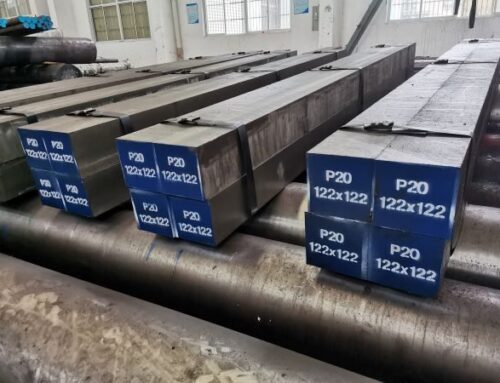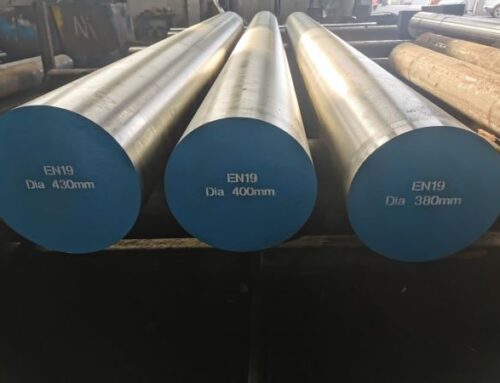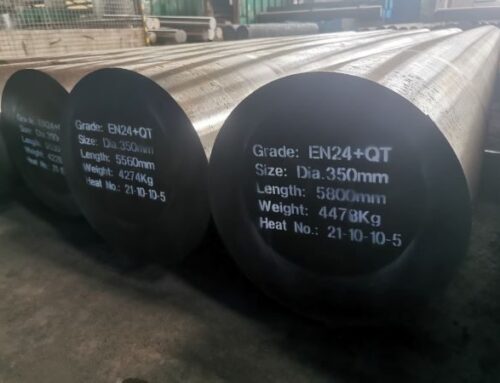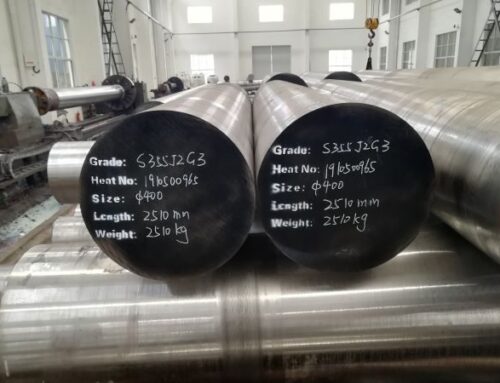
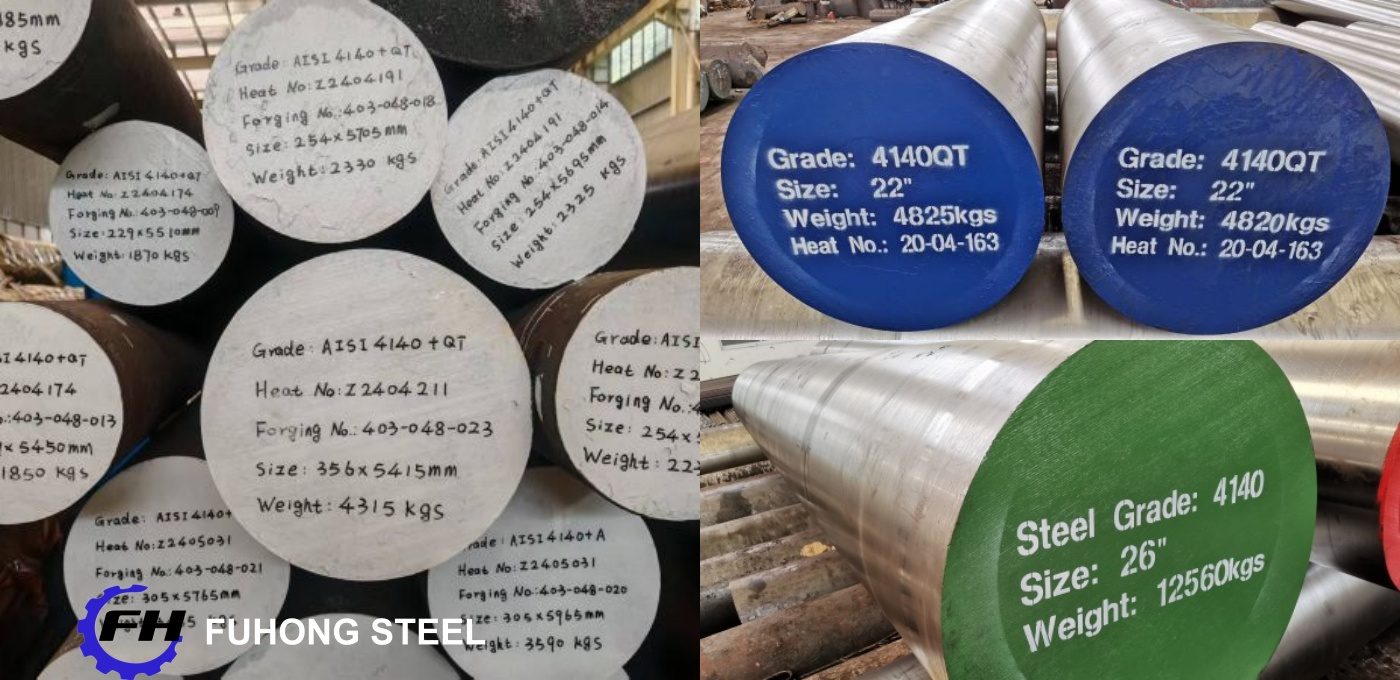
AISI 4140 is a chromium-molybdenum alloy steel with about 0.40% carbon. It is sold under UNS G41400 and produced worldwide under its equivalents 42CrMo4 (EN 1.7225), JIS SCM440 and GB 42CrMo. Buyers pick it for one reason: a single grade covers a wide range of needs, from annealed bar that machines easily to quenched and tempered bar that carries heavy service loads.
This guide covers the composition, mechanical properties, heat treatment, how 4140 compares with 4130 and 4340, and the details you should put in an inquiry.
What is AISI 4140 Steel?
4140 is a low-alloy steel whose carbon content gives it excellent hardenability:0.38–0.43% carbon is enough to reach martensitic hardness after oil quenching.Chromium enhances its hardenability and wear resistance, while molybdenum further strengthens its hardenability and prevents softening during tempering.That combination is why 4140 can be delivered soft for machining and then hardened, or pre-hardened and used straight from the machine.
It is the default choice for shafts, gears, axles, couplings, spindles, hydraulic components and fasteners where a part is machined, heat-treated and put into use.
AISI 4140 Steel Chemical Composition-ASTM A29/A29M
| Element | Range (wt %) | What it does |
| Carbon (C) | 0.38–0.43 | Sets the hardness and strength you can reach after hardening. |
| Manganese (Mn) | 0.75–1.00 | Deoxidizer; adds strength and hardenability. |
| Silicon (Si) | 0.15–0.35 | Deoxidizer; strengthens the ferrite phase. |
| Chromium (Cr) | 0.80–1.10 | Hardenability, wear resistance, resistance to softening during tempering. |
| Molybdenum (Mo) | 0.15–0.25 | Hardenability; reduces temper embrittlement and adds high-temperature strength. |
| Phosphorus (P) | 0.035 max | Controlled impurity; too much lowers toughness. |
| Sulfur (S) | 0.040 max | Controlled impurity; raises machinability in resulfurized variants. |
| Nickel (Ni) | 0.25 max | Residual element, not added for function. |
4140 Steel-At a Glance
4140 Steel Heat Treatment Basics
4140 responds well to heat treatment. Annealed material offers limited performance,but quenching and tempering processing is what develops its balanced strength and toughness, making it a reliable choice for medium-load mechanical parts.
4140 Steel Mechanical Properties-Annealed Condition
Supplied annealed, 4140 machines well and forms predictably. Typical values for bar up to about 100 mm section.
| Tensile Strength (UTS) | Yield Strength (0.2% offset) | Elongation (in 50 mm) | Reduction in Area | Brinell Hardness |
| 655 MPa | 415 MPa | 25% | 57 | ≤ 197 HB |
4140 Steel Mechanical Properties-Quenched and tempered Condition
Quenched and tempered, the same 4140 bar can be delivered from about 930 MPa up to roughly 1750 MPa tensile, depending on the tempering temperature. Typical values after oil quenching from about 845 °C and tempering for 2 hours:
| Tempering Temperature | Hardness | Tensile Strength | Yield Strength | Elongation |
| 205°C | ~54 HRC | 1750 Mpa | 1590 Mpa | 9% |
| 315°C | ~49 HRC | 1600 Mpa | 1450 Mpa | 10% |
| 425°C | ~43 HRC | 1380 Mpa | 1240 Mpa | 14% |
| 540°C | ~37 HRC | 1140 Mpa | 1020 Mpa | 18% |
| 650°C | ~30 HRC | 930 Mpa | 830 Mpa | 22% |
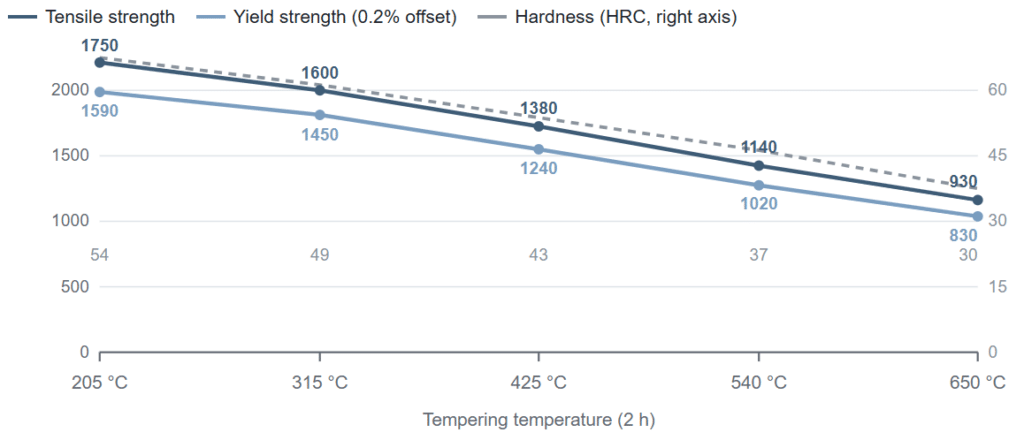
AISI 4140, oil quenched from about 845 °C, tempered 2 h. Typical values for bar up to about 100 mm section.These are typical values, not guarantees.Higher tempering temperature lowers strength and hardness but raises toughness and machinability. Actual results vary with section size, austenitizing practice and tempering time.
4140 Steel Common Applications
4140 vs 4130 vs 4340: Which to Buy?
All three are alloy steels used for parts that look similar, but they cannot be used interchangeably once the size and load of the part are determined.
| Feature | 4130 | 4140 | 4340 |
| Nominal carbon | 0.28–0.33% | 0.38–0.43% | 0.38–0.43% |
| Alloy system | Cr-Mo | Cr-Mo | Ni-Cr-Mo (1.65–2.00% Ni) |
| Hardenability | Lowest of the three | Good | Highest; deep hardening on thick sections |
| Typical Q&T strength | Moderate | High | Highest |
| Weldability | Best | Fair; preheat required | Difficult; preheat and care required |
| Toughness / fatigue | Good | Good | Excellent |
| Relative cost | Low | Medium | High |
| Typical use | Aircraft tubing, welded structures | Shafts, gears, axles, spindles, tooling | Landing gear, heavy crankshafts, high-load shafts |
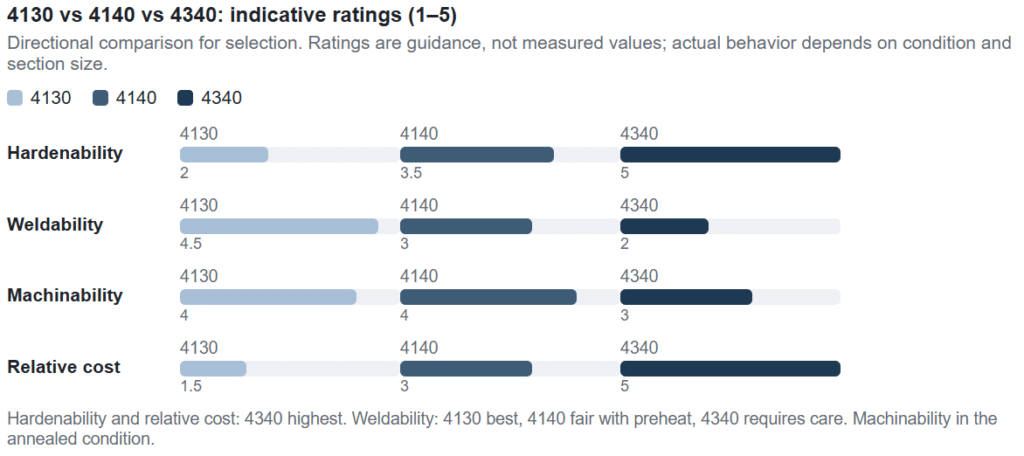
Quick Buying Guide
Pick 4140 when the part will be machined and then hardened, or when you want pre-hardened bar that runs straight through the machine mill.
Pick 4130 when welding comes first and the strength demand is lower; it costs less and welds without the same precautions.
Pick 4340 only when you need deep through-hardening and toughness on large sections. It costs more, machines harder and needs the same preheat discipline as 4140. If the drawing says 4340, do not substitute 4140 without checking section size and impact requirements.
What to Check Before You Order AISI 4140 Steel
FAQ:Buyer Questions
Top questions engineers and procurement teams ask when choosing 4140 alloy steel. Didn’t find your answer? Our technical team is ready to assist.
Planning a project that requires 4140 alloy steel?
√ ISO 9001 Certified √ MTR Included √ Global Shipping √ Custom Cutting √ Technical Support