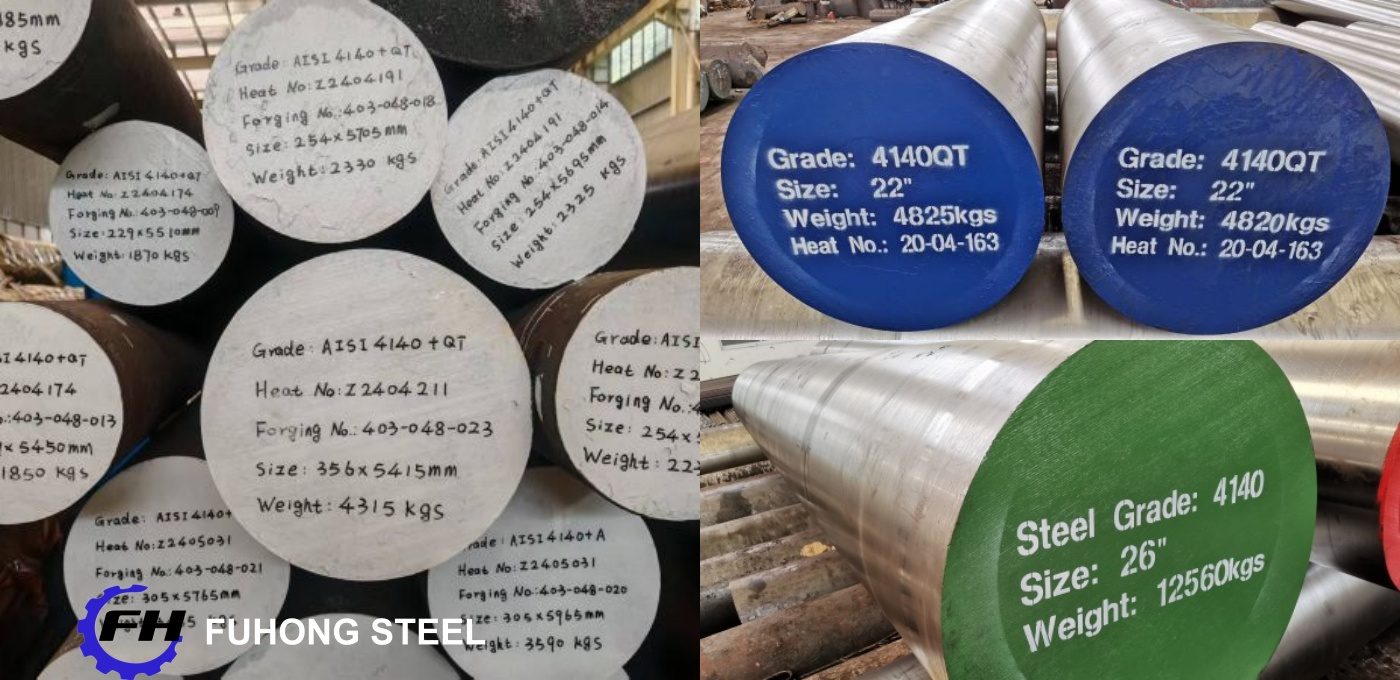
AISI 4140 is a chromium-molybdenum alloy steel with about 0.40% carbon. It is sold under UNS G41400 and produced worldwide under its equivalents 42CrMo4 (EN 1.7225), JIS SCM440 and GB 42CrMo. Buyers pick it for one reason: a single grade covers a wide range of needs, from annealed bar that machines easily to quenched and tempered bar that carries heavy service loads.

This guide covers the composition, mechanical properties, heat treatment, how 4140 compares with 4130 and 4340, and the details you should put in an inquiry.

What is AISI 4140 Steel?

4140 is a low-alloy steel whose carbon content gives it excellent hardenability:0.38–0.43% carbon is enough to reach martensitic hardness after oil quenching.Chromium enhances its hardenability and wear resistance, while molybdenum further strengthens its hardenability and prevents softening during tempering.That combination is why 4140 can be delivered soft for machining and then hardened, or pre-hardened and used straight from the machine.

It is the default choice for shafts, gears, axles, couplings, spindles, hydraulic components and fasteners where a part is machined, heat-treated and put into use.

AISI 4140 Steel Chemical Composition-ASTM A29/A29M

ElementRange (wt %)What it does
Carbon (C)0.38–0.43Sets the hardness and strength you can reach after hardening.
Manganese (Mn)0.75–1.00Deoxidizer; adds strength and hardenability.
Silicon (Si)0.15–0.35Deoxidizer; strengthens the ferrite phase.
Chromium (Cr)0.80–1.10Hardenability, wear resistance, resistance to softening during tempering.
Molybdenum (Mo)0.15–0.25Hardenability; reduces temper embrittlement and adds high-temperature strength.
Phosphorus (P)0.035 maxControlled impurity; too much lowers toughness.
Sulfur (S)0.040 maxControlled impurity; raises machinability in resulfurized variants.
Nickel (Ni)0.25 maxResidual element, not added for function.

4140 Steel-At a Glance

  • Grade family: chromium-molybdenum through-hardening steel, ~0.40% C
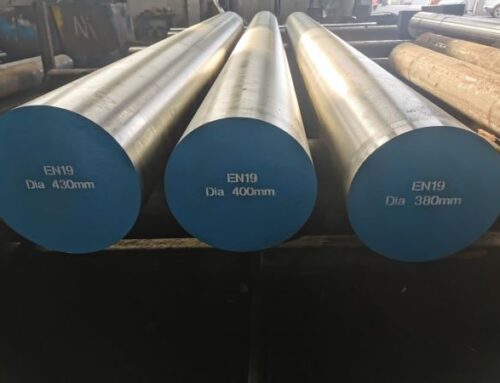
  • Equivalents: 42CrMo4 (1.7225), SCM440, GB 42CrMo, UNS G41400,BS 708M409(EN19)
  • Strength after heat treatment: roughly 930–1750 MPa tensile, depending on tempering
  • Best fit: machined and hardened parts such as shafts, gears, axles, couplings, spindles, fasteners
  • Forms: round bar, flat bar, plate, tube, forged blocks

4140 Steel Heat Treatment Basics

4140 responds well to heat treatment. Annealed material offers limited performance,but quenching and tempering processing is what develops its balanced strength and toughness, making it a reliable choice for medium-load mechanical parts.

4140 Steel Mechanical Properties-Annealed Condition

Supplied annealed, 4140 machines well and forms predictably. Typical values for bar up to about 100 mm section.

Tensile Strength (UTS)Yield Strength (0.2% offset)Elongation (in 50 mm)Reduction in AreaBrinell Hardness
655 MPa415 MPa25%57≤ 197 HB

4140 Steel Mechanical Properties-Quenched and tempered Condition

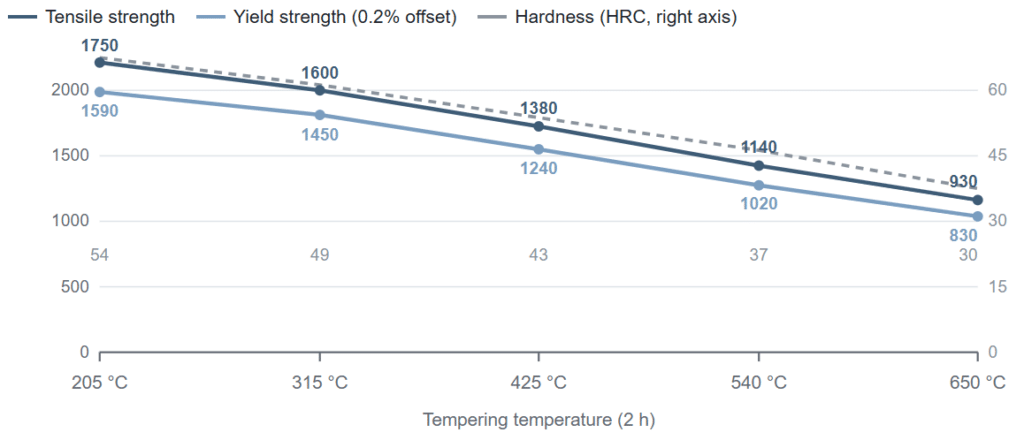
Quenched and tempered, the same 4140 bar can be delivered from about 930 MPa up to roughly 1750 MPa tensile, depending on the tempering temperature. Typical values after oil quenching from about 845 °C and tempering for 2 hours:

Tempering TemperatureHardnessTensile StrengthYield StrengthElongation
205°C~54 HRC1750 Mpa1590 Mpa9%
315°C~49 HRC1600 Mpa1450 Mpa10%
425°C~43 HRC1380 Mpa1240 Mpa14%
540°C~37 HRC1140 Mpa1020 Mpa18%
650°C~30 HRC930 Mpa830 Mpa22%

4140 Tempering temperature vs. mechanical properties

AISI 4140, oil quenched from about 845 °C, tempered 2 h. Typical values for bar up to about 100 mm section.These are typical values, not guarantees.Higher tempering temperature lowers strength and hardness but raises toughness and machinability. Actual results vary with section size, austenitizing practice and tempering time.

4140 Steel Common Applications

  • Shafts, spindles and axles
  • Gears, pinions, couplings and splines
  • Piston rods, cylinder components and hydraulic parts
  • Bolts, studs and fasteners (the same Cr-Mo family as ASTM A193 B7)
  • Machine-tool components and forging tooling
  • Oil and gas components such as valve parts and downhole tooling
  • Crankshafts and connecting rods in smaller sections

4140 vs 4130 vs 4340: Which to Buy?

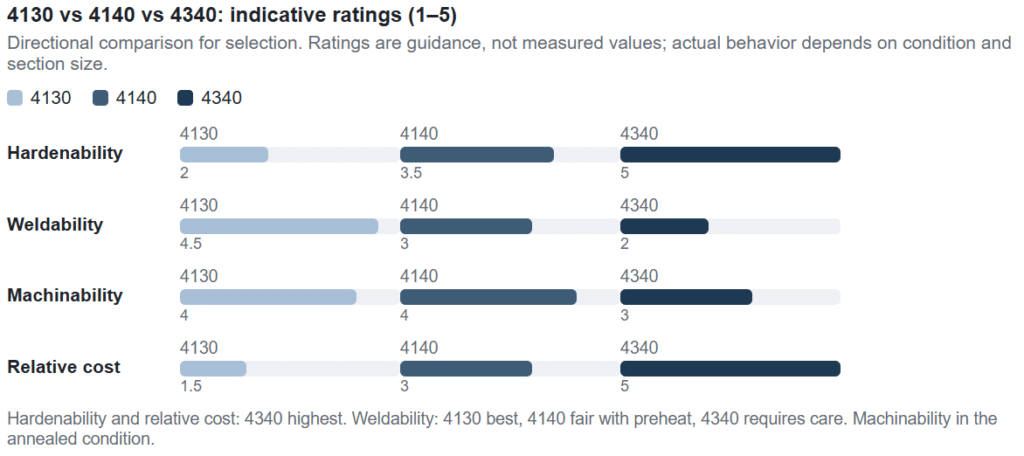
All three are alloy steels used for parts that look similar, but they cannot be used interchangeably once the size and load of the part are determined.

Feature413041404340
Nominal carbon0.28–0.33%0.38–0.43%0.38–0.43%
Alloy systemCr-MoCr-MoNi-Cr-Mo (1.65–2.00% Ni)
HardenabilityLowest of the threeGoodHighest; deep hardening on thick sections
Typical Q&T strengthModerateHighHighest
WeldabilityBestFair; preheat requiredDifficult; preheat and care required
Toughness / fatigueGoodGoodExcellent
Relative costLowMediumHigh
Typical useAircraft tubing, welded structuresShafts, gears, axles, spindles, toolingLanding gear, heavy crankshafts, high-load shafts

4130 vs 4140 vs 4340

Quick Buying Guide

Pick 4140 when the part will be machined and then hardened, or when you want pre-hardened bar that runs straight through the machine mill.

Pick 4130 when welding comes first and the strength demand is lower; it costs less and welds without the same precautions.

Pick 4340 only when you need deep through-hardening and toughness on large sections. It costs more, machines harder and needs the same preheat discipline as 4140. If the drawing says 4340, do not substitute 4140 without checking section size and impact requirements.

What to Check Before You Order AISI 4140 Steel

  • Standard and grade. State AISI 4140 to ASTM A29/A29M, or 42CrMo4 to EN 10277 / ISO 683-1 for European supply. Specify 4140H only if you need the hardenability band.
  • Delivery condition. Hot-rolled, annealed, cold-drawn or pre-hardened. If pre-hardened, give a target hardness range.
  • Size and tolerance. Diameter or thickness, length, straightness, and machining allowance if you will turn it (for example +1–2 mm on diameter).
  • Surface and internal quality. Set decarburization limits, surface defect limits, and ultrasonic testing if the part is fatigue-critical.
  • Mill test certificate. Ask for an EN 10204 3.1 certificate with heat number, chemical analysis and mechanical results, and check the values against the standard.
  • Quantity, packaging and terms. Tonnes or pieces, bundling and anti-rust oil, and the Incoterm and port.

FAQ:Buyer Questions

Top questions engineers and procurement teams ask when choosing 4140 alloy steel. Didn’t find your answer? Our technical team is ready to assist.

Should I buy annealed or pre-hardened 4140 steel?2026-11-13T10:40:07+08:00

If you machine and then heat-treat, buy annealed. If you want to machine and use the part directly, buy pre-hardened (typically 28–32 HRC) and skip the hardening operation.

What determines the price of 4140?2026-11-13T10:36:32+08:00

Section size, delivery condition, quantity, certification level .Complete, spec-matched inquiries get much tighter quotes than vague ones.

Which is stronger, 1045 or 4140?2026-10-05T09:22:34+08:00

4140 hardens deeper and carries more toughness. 1045 wins on material cost and machinability. The question is not which grade is better, but what the duty requires.

How to identify 4140 steel?2026-01-19T19:51:22+08:00

The most direct method to identify 4140 is to use a portable spectrometer, which can quickly and non-destructively detect the main alloying elements and their approximate content, but it cannot measure the most important non-alloy element, carbon content.

The most accurate method: laboratory wet analysis, which provides the exact percentage of all elements.

In addition, some material identification can also be done directly or indirectly by observing sparks and testing hardness.Learn More

Which is harder, 4140 steel or 4340 steel?2026-01-19T18:47:45+08:00

Under the same quenching and tempering process, 4340 can achieve a higher ultimate hardness, meaning 4340 steel is harder than 4140 steel.

However, in practical applications, material selection is not simply a matter of “which is harder,” but rather should consider:

While meeting the necessary hardness/strength requirements, does the material also need higher toughness to withstand impacts? Does it need better fatigue performance to ensure lifespan? Furthermore, practical constraints such as cost, processing difficulty, and cross-sectional dimensions must also be considered.

What are the differences between 4140 steel and 4140H steel?2026-01-12T22:11:56+08:00

4140 steel and 4140H steel are both Cr-Mo alloy structural steels from the same family, with essentially the same composition.

H stands for Hardenability. 4140H has mandatory requirements to guarantee hardenability, which is the core difference.Therefore, 4140H can be considered a version of 4140 with guaranteed hardenability.

Compared to 4140, 4140H represents more stable and controllable hardenability, but also implies stricter quality control and higher cost.It is more suitable for large components requiring high consistency in overall performance after heat treatment.

What is 4140 L80?2026-01-09T21:55:08+08:00

In API 5CT, 4140 L80 corresponds to the 80K yield strength grade defined in the API standard, which is 4140 80K.

4140 L80 steel, through quenching and tempering, achieves a balance between strength and toughness, making it a preferred material for pipes and high-pressure equipment in the oil and gas industry.The following table lists the minimum mechanical property requirement from the API standard.

Yield strength
Tensile strength
Elongation
Reduction in AreaHardnessCharpy V,20℃
≥552 MPa≥655MPa≥18%≥35%18-22HRC≥27J
Is 4140 steel suitable for induction hardening?2026-01-12T08:36:53+08:00

Yes,4140 steel is suitable for induction hardening.

Due to the different frequency of the current, the input depth of the induced current is different during heating.

  • Medium Frequency:With a moderate heating rate, the hardened layer depth can reach 2-10mm, making it suitable for parts requiring strength and toughness.
  • High Frequency:Although it heats up extremely quickly, the hardened layer depth is only 1-2mm, making it suitable for parts with extremely wear-resistant surfaces.

Medium-frequency induction hardening is suitable for small-sized 4140 round steel bars, with minimal deformation, making it suitable for mass production.

Can normalizing be used as the final heat treatment for 4140 steel?2026-01-12T08:37:38+08:00

Before answering, we must first understand the primary purpose of normalizing 4140 steel: to prepare a good microstructure for the final heat treatment. In most cases, normalizing is a pretreatment process.

Secondly, after normalizing, 4140 steel ultimately obtains fine pearlite with a small amount of ferrite (uniform microstructure and refined grains), resulting in improved performance. Normalizing, as the final heat treatment, is sufficient to meet the requirements for non-critical, medium-load parts.

4140+N Mechanical Properties
Tensile Strength Yield StrengthElongationReduction of AreaHardness
≥685MPa≥415MPa≥20%≥50%200-250HB
What are differences between normalizing and annealing for 4140 steel?2026-01-12T08:37:22+08:00

Normalizing and Annealing process is quite commonly used in production for 4140 Steel.The main differences are as follows:

  • Temperature: Normalizing (870-900℃) > Annealing (800-850℃).
  • Cooling rate: Normalizing, air cooling, results in high hardness, while annealing, furnace cooling, results in low hardness.
  • Microstructure and properties: Due to the difference in cooling rates, the microstructure after normalizing is finer than that after annealing, and its properties are improved.

For 4140 steel

  • Normalizing: For better overall performance or as a pretreatment for subsequent strengthening processes.
  • Annealing: For softening, stress relief, and improved machinability.

Planning a project that requires 4140 alloy steel?

Send details to us with the drawing or specification attached, and you will get a quotation you can actually compare.

√ ISO 9001 Certified √ MTR Included    √ Global Shipping  √ Custom Cutting    √ Technical Support

GET OFFER FROM US NOW!
By |2026-11-14T08:40:09+08:00November 4th, 2026|Steel Guide|Comments Off on AISI 4140 Alloy Steel:Full Technical Guide for Engineers and Buyers

Share This Article, Choose Your Platform!

Go to Top