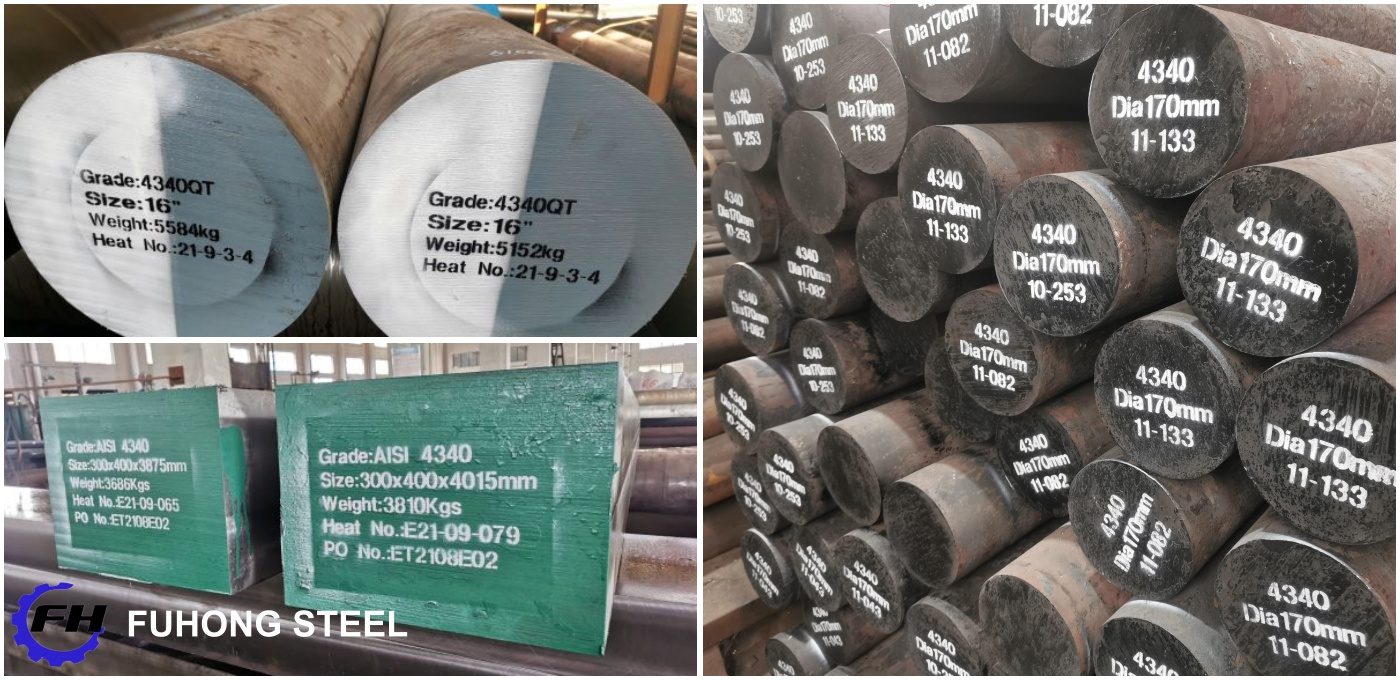
When industrial projects demand extremely high strength, deep hardenability, and exceptional toughness under extreme loads and fatigue conditions, 4340 steel is a worthy consideration, perfectly suited to meet these challenges.
As a premium nickel-chromium-molybdenum alloy steel, 4340 steel is widely trusted in the aerospace, heavy machinery, motorsports, and defense industries, solving critical engineering problems that ordinary carbon steel and chromium-molybdenum steel cannot handle.
What is 4340 Steel?
AISI 4340 is a medium-carbon nickel-chromium-molybdenum low-alloy steel. Unlike the nickel-free 4130 and 4140 chromium-molybdenum steels, 4340 contains 1.65% to 2.00% nickel, which is its distinctive characteristic. This unique alloy composition endows 4340 with excellent hardenability, impact toughness, and fatigue resistance.
4340 steel is renowned for achieving uniform hardness across thick sections while maintaining excellent ductility. It is the material of choice for high-stress components where the tolerance for structural failure must be zero, making 4340 steel indispensable in aerospace and heavy industrial manufacturing.
Chemical Composition of 4340 Steel
| Grade | C | Si | Mn | P | S | Cr | Ni | Mo |
| 4340 | 0.38-0.43 | 0.15-0.35 | 0.6-0.8 | ≤0.035 | ≤0.04 | 0.7-0.9 | 1.65-2.00 | 0.2-0.3 |
Among these elements, nickel enhances toughness and impact resistance, chromium improves hardenability and corrosion resistance, and molybdenum enhances high-temperature strength and helps prevent temper brittleness.
Because of its balanced alloy content, 4340 responds extremely well to quenching and tempering, making it a go-to choice for components that must withstand high loads, shock, and repeated cyclic stress.
Why Choose 4340? Four Key Properties That Matter for Buyers
High Tensile & Yield Strength
After quenching and tempering, 4340 steel typically achieves a tensile strength of 1000–1300 MPa. Yield strength follows closely behind, meaning parts can maintain their shape under heavy loads without permanent deformation. For gears, shafts, and structural components, this means smaller, lighter parts can be designed while still meeting safety margin requirements.
Excellent Toughness & Impact Resistance
Unlike some higher-carbon alloys that become brittle after hardening, properly tempered 4340 retains strong Charpy V-notch impact values. This toughness is especially critical in dynamic applications — think axle shafts, connecting rods, and hydraulic components — where sudden shock loads cannot be tolerated.
Good Through-Hardening
Due to the presence of nickel and molybdenum, 4340 steel has significantly better hardenability than ordinary carbon steel or simpler alloys like 4140. Larger cross-sections allow for a more uniform internal martensitic structure, not just on the surface. This is one of the main reasons buyers choose 4340 over other alternatives for thick-walled or solid-section parts.
Good Fatigue Resistance
Components subjected to repeated loads benefit from the excellent fatigue resistance of 4340, especially when the surface is properly finished, shot-peened, or nitrided. In rotating and reciprocating machinery, fatigue life often determines replacement cycles—and 4340 typically provides a long and predictable service life.
4340 Steel Heat Treatment Basics
4340 is designed to be heat-treated. Its properties in the annealed state are unremarkable — the magic happens after quenching and tempering.
4340 Performance Boost – Heat Treatment Magic
Property Annealed / Normalized Quenched & Tempered
Tensile Strength 650 – 850 MPa → 980-1100 Mpa
Yield Strength 470 – 680 MPa → 750-900 Mpa
Impact Toughness Good → Excellent
Hardness 180-229 HBW → 280-320 HBW
After proper quenching and tempering, 4340 steel possesses both extremely high strength and good toughness. While many steels experience a decrease in toughness with increased hardness, 4340 steel maintains its toughness, especially its impact strength at low temperatures.
Four Top Industrial Applications For 4340 Steel
4340 steel is exclusively used for critical components where safety and durability are paramount. Its high performance justifies its premium cost across key industries
Aerospace Industry
As a certified aerospace-grade alloy, 4340 (especially VAR/ESR refined versions) is widely used for aircraft landing gear, structural fittings, engine mounts, and helicopter transmission shafts. Its exceptional impact toughness prevents catastrophic failure during takeoff, landing, and turbulence.
Automotive & Motorsports
High-performance racing engines and heavy-duty vehicles rely on 4340 steel crankshafts, connecting rods, drive axles, and suspension components. Its outstanding fatigue resistance withstands repeated high-speed and high-torque cyclic loads.
Heavy Machinery & Power Generation
Large-diameter turbine shafts, hydraulic cylinder rods, gear shafts, and heavy forgings all use 4340 steel. Its deep hardenability ensures uniform strength throughout thick industrial parts.
Defense & Ordnance
Military vehicle components, gun barrels, and high-pressure ordnance parts adopt 4340 steel for its extreme impact resistance and long service life under harsh combat conditions.
4340 Steel vs. Other Common Alloys
Let’s keep this practical. How does 4340 compare to the steels you’re probably already considering?
4340 vs. 4140
This is the most common comparison. 4140 is a chromium-molybdenum steel — no nickel. It’s cheaper than 4340 and still plenty strong, but it doesn’t harden as deeply and isn’t as tough, especially in larger sections.
4140 is suitable for small parts or situations where cost is the primary consideration. If deeper hardening or toughness for thicker cross-sections is required, 4340 should be chosen.
4340 vs. 8620
8620 is a low-carbon case-hardening steel. You carburize it to get a hard, wear-resistant surface while keeping a soft, tough core. It’s great for gears that need surface hardness, but its core strength doesn’t come close to 4340.
8620 is suitable for surface-wear applications. 4340 is suitable for applications requiring overall hardening and high core strength.
4340 vs. 4330
4330 is essentially a low-carbon version of 4340 (carbon content is approximately 0.30%, while 4340 is approximately 0.40%). Lower carbon content means lower peak strength, but better weldability and slightly improved toughness. If welding is required, 4330 is generally the wiser choice.
Need welding? Consider 4330. Need maximum strength? 4340 is superior.
Frequently Asked Questions
Frequently asked questions by purchasing personnel and engineers when selecting 4340 steel.Can’t find what you’re looking for? Please contact our technical team.
Need 4340 steel for your upcoming project?
√ ISO 9001 Certified √ MTR Included √ Global Shipping √ Custom Cutting √ Technical Support