1045 steel isn’t the strongest steel, nor is it the most corrosion-resistant, and it’s not as sharp as tool steel. So why is it so ubiquitous?The answer: balance. 1045 steel achieves a perfect balance between strength, toughness, machinability, and cost, which is why engineers continue to choose it.
This article will delve into 1045 steel. Perhaps in ten minutes, you’ll be able to roughly determine whether 1045 steel meets your needs.
What Exactly is 1045 Steel?
The name “1045” follows the AISI/SAE four-digit steel numbering system. The first digit, “1,” tells you it is a plain carbon steel. The second digit, “0,” means there are no significant alloying additions .The last two digits, “45,” indicate a nominal carbon content of 0.45%.
| Grade | C | Si | Mn | P | S |
| 1045 | 0.43-0.50 | 0.15-0.35 | 0.60-0.90 | ≤0.04 | ≤0.05 |
That’s the whole secret. The core component of 1045 steel is iron, with a carbon content of about 0.45% and a very low manganese content. Its strength, hardness, and other properties all stem from this simple formula.
1045 goes by different names in different standards, but they all describe essentially the same material:
| Standard | Designation | Region |
| AISI/SAE | 1045 | United States |
| EN/DIN | C45/1.0503 | Europe |
| JIS | S45C | Japan |
| GB | 45# | China |
1045 Steel Heat Treatment Basics
The composition of raw materials only tells half the story. The other half depends on the steel’s performance under load. The same 1045 steel can have a balance of hardness, machinability, and wear resistance, largely depending on its heat treatment.
| High-temperature tempering | Medium temperature tempering | Low-temperature tempering |
| 550-650℃ | 350-500℃ | 150-250℃ |
| 20-30HRC | 33-38HRC | 55-60HRC |
| High-performance parts | Elastic parts | High wear-resistant parts |
1045 Performance Boost – Heat Treatment Magic
| Property | As Rolled/ Normalized | Quenched & Tempered | |
| Tensile Strength | 600 – 700 MPa | → | 700 – 950 MPa |
| Yield Strength | 350 – 400 MPa | → | 500 – 700 MPa |
| Hardness | 170 – 210 HB | → | 200 – 280 HB |
| Elongation | 16 – 20% | 10 – 15% | |
| Impact Toughness | 40 – 60 J | 30 – 50 J |
These data clearly demonstrate that, in its factory condition, 1045 steel is a steel with moderate strength and good toughness. After quenching and tempering, its strength and hardness increase by approximately 30% to 40%, but at the cost of decreased elongation and impact toughness. This trade-off is a fundamental characteristic of all carbon steels, and 1045 steel is no exception.
Typical Application-Where 1045 Steel Actually Gets Used
1045 is a general-purpose medium-carbon steel, and its applications reflect that identity. You will find it anywhere a part needs moderate strength, reasonable toughness, and the ability to be machined without fighting the tooling.
Automotive & Transportation
Crankshafts, connecting rods, axle shafts, gears, sprockets, and steering components. These parts rotate under load, absorb shock, and need to survive millions of cycles.
1045 steel, usually quenched and tempered or induction hardened, hits the strength-to-cost ratio that makes mass production viable.
Industrial machinery
Shafts, spindles, gears, rollers, cams, couplings, and hydraulic cylinder rods. In a factory, these are the parts that transmit power and motion. They do not need exotic properties,just need to be strong, dimensionally stable, and replaceable at a reasonable cost.
Fasteners & Hardware
Bolts, studs, nuts, and pins in the medium-to-high strength range. 1045 can be heat treated to meet Grade 8 / Class 10.9 equivalents, making it suitable for structural connections where mild steel fasteners would be inadequate.
Tools & Tooling
Not suitable for cutting tools—cutting tools require tool steels such as D2 or M2.
However, for fixtures, tooling, gauges, dies, and forming tools that require a hard surface and tough body, induction hardened 1045 steel is a common and economical choice.
Agricultural & Construction Equipment
Plow shares, cultivator points, loader pins, and various wear parts. These components are subjected to tremendous stress in dirty, high-wear environments. 1045 steel is typically surface-hardened, ensuring sufficient wear resistance without the cost of through-hardened alloy steels.
Quick Answers to Common Questions About 1045 Steel
Related Carbon Steel Products By Fuhong Steel

S235JR Cold Drawn Flat Bars For Construction Joints Use

SAE 1020 Carbon Steel | AISI 1020 Steel Bar

DIN 1.1730 Tool Steel | C45W-DIN 17350 Standard
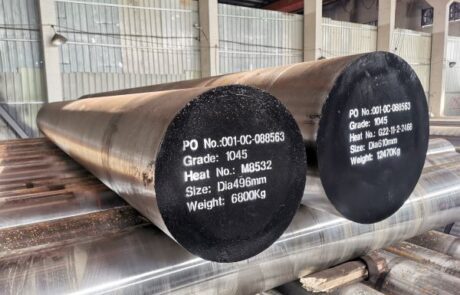
SAE 1045 Steel Bar | AISI 1045 Carbon Steel-ASTM A29

C50 Carbon Steel | CK50 | AISI 1050

C40 Carbon Steel | CK40 | DIN 1.0511

C35 Carbon Steel | CK35 | DIN 1.0501

CK45 Carbon Steel | DIN 1.1191-SEW550

28Mn6 Quality Special Steel | DIN 1.1170 | 150M28