What is Forging Ratio?
The forging ratio of special steel is one of the key parameters in the forging process, which directly affects the material’s density, grain refinement, mechanical properties and defect elimination effect. Its specific value varies depending on the material type, application and process requirements, and usually needs to be determined by combining theoretical calculations and practical experience.
Forging ratio is an indicator to measure the degree of plastic deformation of forgings, which is usually calculated in the following two ways:
- Cross-sectional area ratio: Forging ratio = original cross-sectional area/cross-sectional area after forging
- Length ratio: Forging ratio = length after forging/original length
For example, if a cylindrical billet is forged from a diameter of 200mm to 100mm, the forging ratio is ((200/100)^2 = 4). In the drawing process, if the cross-sectional area is reduced from 1000mm² to 250mm², the forging ratio is (1000/250 = 4).
Generally, a forging ratio > 2 is required to effectively improve the material structure, but the specific value needs to be adjusted according to the process.
Typical Process:Forging Ratio Range
| Process type | Forging ratio | Description |
| Free forging-Drawing | 3~5 (common),Up to 10 | For shafts and rods; high alloy steel or difficult to deform materials may require a higher ratio. |
| Free forging-Upsetting | 2~3 | Avoid excessively high ratios that lead to instability or folding defects. |
| Die forging | 1.5~3 | Due to die limitations, the deformation is small and suitable for parts with complex shapes. |
| Multiple upsetting and drawing | Total ratio 6~10 | Accumulated through multiple upsetting and drawing, used for high-quality forgings (such as aviation turbine disks). |
Typical Special Steels:Forging Ratio Range
The forging ratio of special steels (such as tool steel, stainless steel, high-temperature alloy, high-strength structural steel, etc.) is usually higher than that of ordinary steels to improve their microstructure and performance. The common range is as follows:
- General special structural steel:3~6
- Tool steel:5~8
- Stainless steel:4~7
- High-temperature alloys:6~10
- Titanium alloys and special metals:5~12
What Factors Affecting Forging Ratio?
1. Material properties
Materials with high alloying element content (such as high-speed steel and nickel-based alloys) require a higher forging ratio to homogenize the structure.When there are many defects in the as-cast structure (shrinkage cavities, porosity), a large forging ratio is required to eliminate them.
2. Process purpose
For ordinary forgings, a forging ratio of 3 to 5 is sufficient to meet performance requirements.However, for high-reliability parts (such as aircraft engine blades), the forging ratio must be greater than 8, and can be even higher through multi-directional forging.
3. Process route
For multiple forging processes, the total forging ratio is the product of the forging ratios of each individual forging (for example, if the forging ratios of both forging processes are 4, then the total forging ratio is 16). For materials that are difficult to deform, isothermal forging is required, which can appropriately reduce the forging ratio, but the holding time needs to be extended.
4. Equipment capacity limitations
Large forgings are limited by the tonnage of the press and may not be able to reach the theoretical forging ratio, so the process path needs to be optimized.
How Does the Forging Ratio Affect Material Properties?
- Grain refinement: The larger the forging ratio, the more complete the dynamic recrystallization and the smaller the grain size (for example, when the forging ratio increases from 3 to 8, the grain size can be increased from ASTM grade 5 to grade 8).
- Anisotropy: Too high a forging ratio may cause excessive extension of fiber streamlines and produce directional mechanical differences.
- Defect control: When the forging ratio is ≥4, shrinkage holes and microcracks can be effectively closed.
- Balance between strength and toughness: When the forging ratio is insufficient (<3), the material toughness is low; when it is too high (>10), the plasticity may decrease due to work hardening.
How to Choose the Forging Ratio?
The forging ratio of special steel is generally between 3 and 10, and should be determined according to the following principles:
- Lower limit: at least 3 to ensure basic density and defect elimination.
- Upper limit: not exceeding the plastic limit of the material
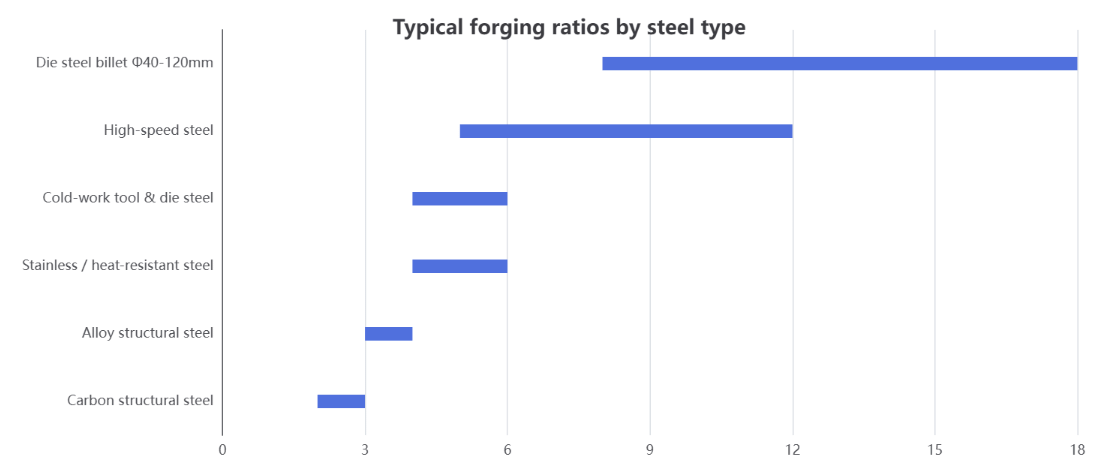
For forging ratios for general special steels are typically 3–5 (at least 3). The more alloying elements (the more severe the carbide segregation), the higher this ratio becomes.For example, high-speed steel can reach 5–12, while ultra-high-strength steel exceeds 12. When the forging ratio is below 2, the densification effect is minimal, while extremely high ratios increase the anisotropy between longitudinal and transverse properties.
Finally, the rationality of the forging ratio needs to be verified through metallographic inspection and mechanical property testing.