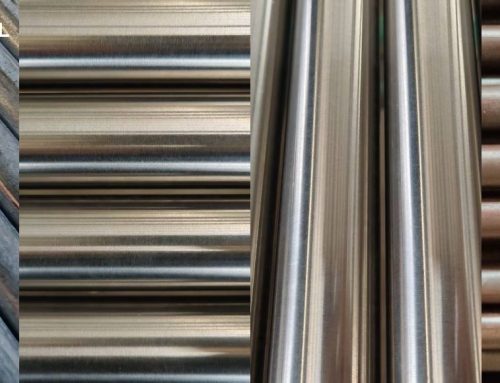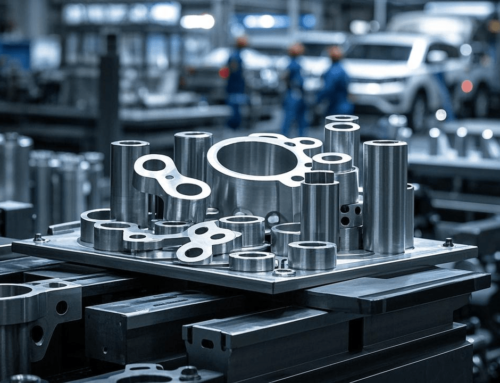

Walk through any machine mill and you will find 1045:round bar, flat bar, plate, and sometimes forgings.The reason is simple. It contains enough carbon (0.43%–0.50%) for hardening, enough manganese to maintain predictable strength, and unlike 4130 or 4140 steel, it doesn’t contain additional alloying elements. For parts under moderate load, it is usually the cheapest way to get dependable mechanical properties in the plain-carbon range.
This article covers what 1045 is, what heat treatment can and cannot do for it, where it is actually used in machinery manufacturing, and how to choose 1045 steel.
What is 1045 Steel?
AISI 1045 is a plain medium-carbon steel in the SAE J403 / ASTM A29 family. “Plain”means: it has no deliberate chromium, nickel, or molybdenum. Its performance comes from carbon and manganese, and its price reflects that.
| Grade | C | Si | Mn | P | S |
| 1045 | 0.43-0.50 | 0.15-0.35 | 0.60-0.90 | ≤0.04 | ≤0.05 |
1045 fall between the low-carbon grades (1018, 1020), which machine easily but will not harden, and the alloy steels (4140, 4340), which harden deep and cost more.1045 can be hardened, but only reliably in thin sections.This limitation, rather than other factors, determines the applications of 1045.
Equivalent grades you will meet in the same application:
| Standard | Grade |
| SAE / AISI (ASTM A29) | 1045 |
| JIS (Japan) | S45C |
| DIN / EN (Germany, EU) | C45 / C45E (1.1191) |
| BS (UK) | EN8 / 080M40 |
| GB (China) | 45 |
These grades have similar but not identical chemical compositions and properties.Please verify before making a substitution.
1o45 Steel Heat Treatment & Mechanical Property Basics
1045 steel heat treatment routes
| Process | Temperature | Cooling | What it does |
| Normalizing | 840 – 880 °C | Still air | Refines grain, evens out structure, improves machinability |
| Soft annealing | 680 – 710 °C | Slow furnace cool | Softens for heavy machining or cold forming |
| Quenching | 820 – 860 °C | Water or oil quench | Forms martensite; water is needed for full hardness in 1045 |
| Tempering | 400 – 650 °C | Air | Adjusts the hardness / toughness balance |
| Stress relieving | 600 – 650 °C | Furnace or air | Removes machining or welding stress |
| Induction hardening | 820 – 860 °C | Water quench | Localized wear resistance, 54 – 60 HRC |
1045 steel mechanical properties in common supply conditions
| Condition | Tensile strength | Yield strength | Elongation | Hardness |
| Hot rolled | 570 – 700Mpa | 310 – 450Mpa | 16 – 20% | 170 – 210 HB |
| Normalized | about 621Mpa | about 379Mpa | about 18% | about 180 HB |
| Annealed | about 517Mpa | about 345Mpa | about 17% | about 150 HB |
| Cold drawn | about 586Mpa | about 517Mpa | about 15% | about 200 HB |
| Q&T, tempered about 650 °C | about 758Mpa | about 552Mpa | about 17% | about 220 HB |
Charpy V-notch impact on normalized bar is typically 39 J or higher at room temperature.
Hardness after heat treatment depends on the route, not just the grade:
- Water quench, thin section: about 50 – 55 HRC as quenched.
- Induction hardened surface: 54 – 60 HRC, common for gear teeth and bearing journals.
- Tempered to a working hardness: most machine parts run at 25 – 35 HRC, balancing wear and toughness.
Where is 1045 Steel Actually Used?
1045 shows up in machinery wherever the load is moderate, the section is not huge.The list below is where it is used in practice.
Shafts and Axles
Transmission shafts, line shafts, conveyor shafts, pump shafts in non-corrosive service, and light to medium-duty axle shafts are typical machined parts made of 1045 steel.It machines cleanly for keyways, threads, splines, and bearing journals can be induction-hardened to 54 – 60 HRC without hardening the whole shaft.
When bearings are subjected to high speeds, high cyclic loads, or heavy impacts, 4140 or 4340 should be selected, rather than excessively using 1045.
Gears and Gear Blanks
Light and medium-duty gears, transmission gears, sprockets, and gear blanks are typically machined from 1045 steel.The common route is to machine the gears in a normalized or annealed state, followed by induction hardening and tempering.
For heavy-duty or impact-sensitive gear sets,where you need a hard case and a strong core, carburized steel (such as 8620) or solid-hardened alloys (such as 4140) are safer choices.
Fasteners, Studs, Pins, and Keys
Bolts, studs, dowel pins, taper pins, gib keys, and locating pins are all made of quenched and tempered 1045 steel.With a hardness of 25-35 HRC,they get a useful balance of wear resistance and toughness at a price that keeps high volumes practical.
Couplings, Flanges, and Collars
Rigid and flexible couplings, flange halves, spacer rings, and shaft collars prioritize stiffness and rigidity over extremely high strength.1045 gives the needed section strength with easy machining and low material cost.
Piston Rods, Cylinder Rods, and Guides
Hydraulic and pneumatic piston rods, cylinder guides, and plungers are typically made of 1045 with an induction-hardened surface.The hardened layer withstands wear, while the tough core withstands bending.
Crankshafts and Connecting Rods
Small-engine crankshafts, low-speed compressor cranks, connecting rods, and camshafts for modest service are made from 1045 when the duty is light and the volume is high.For high-cycle fatigue applications, forged alloy steel should be used,the fatigue margin of 1045 is insufficient for such applications.
Machine Tool and Die Components
Mold bases, die sets, bolster plates, and general machine frames use 1045 for dimensional stability after normalized and stress-relieved.
Agricultural and Construction Machinery
Tractor and tiller shafts, mower spindles, loader pins, and hydraulic component bodies are cost-sensitive medium-load components,which is where 1045 competes with higher-priced alloys.
Comparison With Other Grades
| Grade | What makes it good | What it used |
| 1045 | Low cost, good processability, moderate strength | Medium and low load shafts, fasteners, structural parts |
| Q235B | Lower cost, but weak strength (yield 235 MPa) | Lightweight structures such as non-load-bearing brackets and shells |
| 4140 | High strength, fatigue resistance (tensile strength ≥850 MPa) | High stress gears, crankshafts, aviation parts |
| 304 | Strong corrosion resistance, but high cost and low strength | Food machinery, chemical environment |
1045 vs 1040 vs 4140: How to Choose?
| Property | 1040 | 1045 | 4140 |
| Type | Plain medium carbon | Plain medium carbon | Cr–Mo alloy steel |
| Carbon (%) | 0.37 – 0.44 | 0.43 – 0.50 | 0.38 – 0.43 |
| Typical tensile (MPa) | about 570 – 620 (hot rolled) | 570 – 700 | about 655/annealed about 930 – 1020/ Q&T |
| Hardenability | Limited | Limited through-hardens to about 60 mm | Excellent thick sections harden |
| Machinability | Excellent | Good about 60 – 70% of 1212 | Lower about 50 – 55% annealed |
| Weldability | Easier with preheat | Moderate preheat 150 – 260 °C, slow cool | Harder strict preheat plus PWHT |
| Relative cost | Lowest | Low | Higher |
| Typical use | Light shafts, general parts | General machinery shafts, gears | High-load, fatigue-critical parts |
Choose 1045 when the part carries moderate static or dynamic load, the section stays under roughly 60 mm if you need through-hardening, and machining volume or piece cost matters more than peak strength.
Choose 1040 when loads are light and you want the easiest welding and machining
Choose 4140 when the section is heavy, the service is fatigue or impact dominated, or you need oil-quench through-hardening and better toughness.
Frequently Asked Questions
Quick answers to the most common questions about 1045 carbon steel. Can’t find what you’re looking for? Contact our technical team.
Ready to Buy 1045 Steel for Your Application?
√Form: round/flat/plate/forging/customized
√Size and quantity
√Condition required
√Machining or heat-treatment scope
√Destination port or incoterm