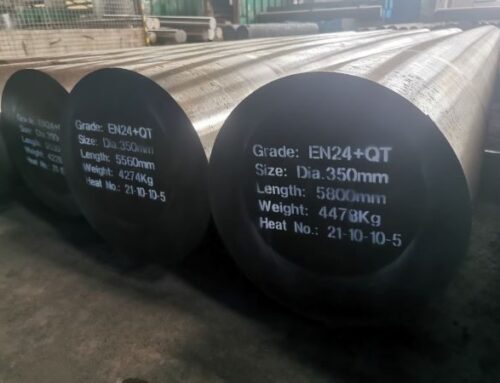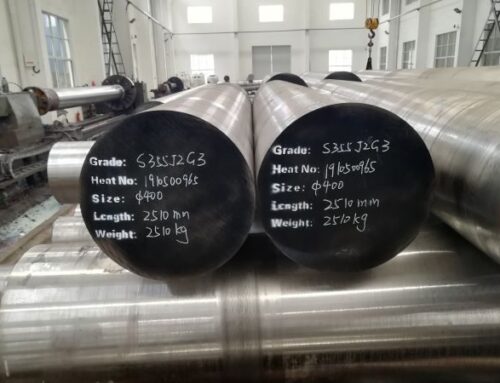
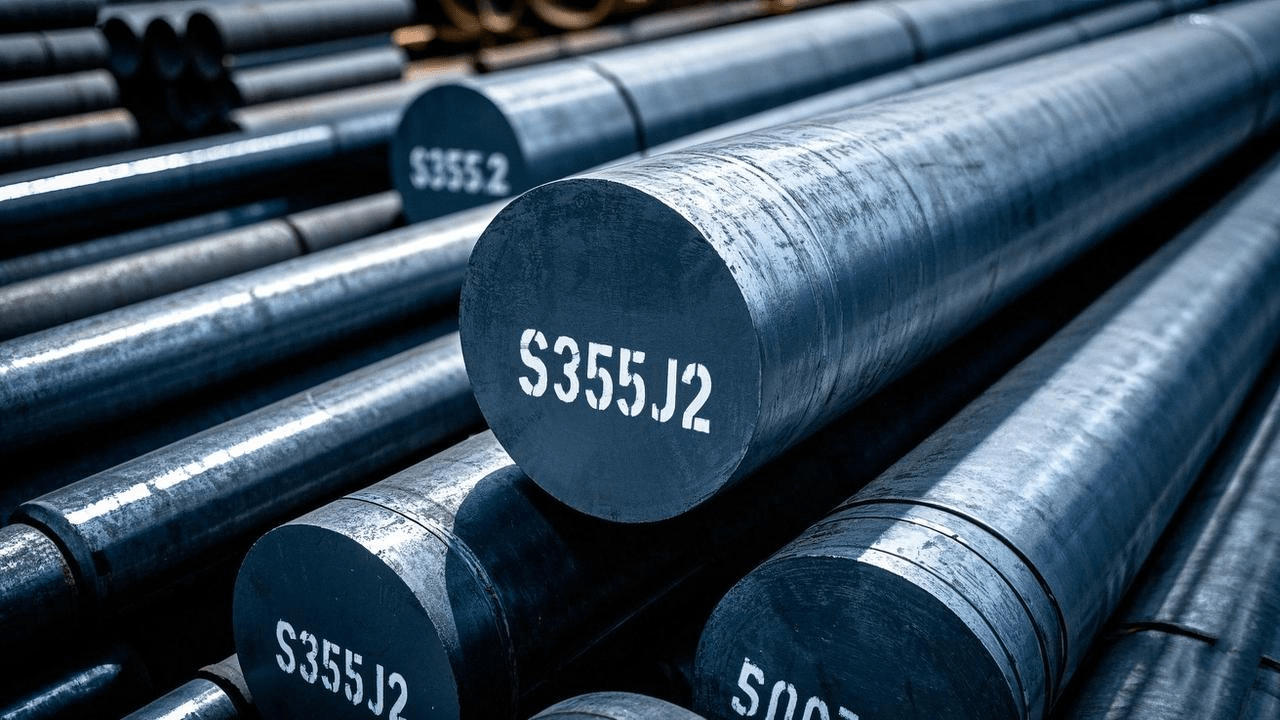
You may have seen steel grades like S355J2, S355J2G3, and S355JR on steel structure drawings. You might wonder: they all look similar, so what changes do the extra letters bring? Can they be substituted for each other?
The answer is No. This article will focus on explaining the true meaning of the S355J2 designation, its differences from other S355 series grades, and its application in actual engineering projects.
What Does S355J2 Steel Actually Means?
S355J2 is not a name given arbitrarily. It is a non-alloy structural steel grade that conforms to the European standard EN 10025-2, and each character has a specific meaning.
S — Structural steel. This type of steel is specifically designed for load-bearing structures, rather than tools, stainless steel applications, or specialty alloys.
355 – Minimum yield strength, megapascals (MPa), applicable to plates with a thickness not exceeding 16 mm.In fact, this material can withstand approximately 355 kg of force per square millimeter before permanent deformation occurs. This is about 50% higher than common low-carbon steels (such as Q235), meaning that smaller cross-sections can withstand the same load.
J2 – Low-temperature impact toughness rating. “J” refers to the Charpy V-notch impact test, and “2” indicates that the test temperature is -20°C with a minimum absorbed energy of 27 Joules. This is the part that gets overlooked most often,but it matters more than most people realise.
In summary, S355J2 is a non-alloy structural steel with a minimum yield strength of 355 MPa, guaranteeing to absorb at least 27 joules of impact energy at -20°C. Its material number is 1.0577, and it is one of the most widely used structural steels in European and international projects.
The S355 Family: How JR, J0, J2, and K2 Really Differ
S355 is not a single grade,but an entire strength class. The suffixes JR, J0, J2, and K2 are what set them apart.
All four grades share the same yield strength (355 MPa) and tensile strength range (470–630 MPa). Their chemical composition limits are essentially identical too. The single core difference lies in the temperature and energy requirements of the impact test.
| Suffix | Impact test temperature | Minimum impact energy (Charpy V-notch) | Delivery status |
| JR | +20°C | ≥27 J | Hot rolled (HR) |
| J0 | 0°C | ≥27 J | Hot rolled or normalized (N) |
| J2 | -20°C | ≥27 J | Hot rolled or normalized (N) |
| K2 | -20°C | ≥40 J (higher toughness requirement) | Normalizing (N) |
Other suffixes
- G3: Indicates that the steel has been normalized and rolled, with a more uniform grain structure and stability, suitable for welding and low temperature environments.
- N: Normalized, improves mechanical properties and toughness.
- M: Thermomechanical Rolling, suitable for high strength requirements.
S355 steel: Applications
| Grade | Applicable Environment | Typical Engineering Cases |
| S355JR | Normal temperature, no low temperature impact requirements | Ordinary building frames, plant structures |
| S355J0 | Low temperature environment above 0°C | Bridges and light machinery in temperate regions |
| S355J2 | -20°C cold environment | Bridges in cold regions, ship decks, wind turbine towers |
| S355J2G3 | -20°C environment with high welding requirements | Liquefied natural gas (LNG) storage tanks, precision welded structures |
| S355K2 | Extreme low temperature or high impact load | Arctic oil and gas platforms, heavy-duty crane booms |
S355 steel:International Standard
| Grade(EN) | ASTM (USA) | GB/T (China) | JIS (Japan) |
| S355JR | A283 Gr.C | Q355B | SM490A |
| S355J2 | A572 Gr.50 | Q355D | SM490YB |
| S355K2 | A633 Gr.C | Q355E | SM520 (Special Grade) |
Core Properties:Why Choose S355J2 Steel?
The reason why S355J2 has become the preferred steel in the international engineering field is not because it excels in a single indicator, but because it balances multiple key performance characteristics within a reasonable cost range.
Adequate strength
Its yield strength is 355 MPa, far exceeding that of ordinary low-carbon steel (approximately 235 MPa), but lower than that of high-strength steel, which requires complex welding processes.
For most building and bridge structures, this strength level is just right, significantly reducing weight without adding excessive processing difficulty.
Related topic: When selecting structural steel, is higher strength always better?
It’s easy to assume that if S355 is better than S235, then S460 or S690 must be even better. The problem is that high-strength steels have a higher carbon equivalent, meaning stricter preheating requirements and more complex field welding. Manufacturing costs and complexity also increase significantly.
Furthermore,many structures are controlled by stiffness or fatigue, rather than strength.n such cases, increasing the steel grade will not reduce the cross-sectional dimensions, but will only increase costs unnecessarily. The reason why S355J2 has become the mainstream steel grade is precisely because it achieves the ideal balance between strength and machinability.
Guaranteed low-temperature toughness
This is precisely the difference between J2 and JR. The -20°C / 27 J guarantee means that this steel will not suddenly become brittle, even in northern winters, high-altitude areas, or marine environments.
For structures subjected to vehicle loads, wind, or wave action, the ability to maintain toughness without fracturing under unexpected impacts is more important than the raw strength values on the datasheet.
Good weldability
The carbon equivalent of S355J2 is typically between 0.40% and 0.45%, which places it firmly in the “good weldability” category.
Traditional SMAW, GMAW, and SAW welding processes can be performed without complex preheating or post-heat treatment. On the construction site, simpler welding processes mean tighter schedules and more consistent quality.
Good ductility & Formability
This steel has a minimum elongation of 22%, meaning it can undergo considerable deformation before fracture.
For components that require cold bending, rolling, or pressing, this ductility directly determines whether the material will crack during processing.
Moderate hardness
Brinell hardness typically stays under 163 HB, which means machining and drilling proceed without excessive tool wear,unlike harder grades that can dull cutting edges quickly.
These advantages are precisely why S355J2 steel appears on the specifications lists of various industries. While it may not be the best in any single performance aspect, it is the most reliable choice in terms of cost-effectiveness for most structural engineering applications.
S355J2 Industrial Applications: From Long-Span Bridges to Offshore Wind
The S355J2 has a wide range of applications, but different industries choose it for different reasons. The following classification is based on application areas.
- Bridges and Civil Infrastructure:The main girders, deck plates, and steel cofferdams of long-span bridges are among the most classic applications for S355J2.
- Offshore and Coastal Structures:Offshore oil platforms, offshore wind turbine towers, and port machinery steelwork are where S355J2 really earn their specification.
- Building Structures:Steel frames in high-rise buildings, long-span roof trusses in sports stadiums, and crane girders in industrial plants all commonly use S355J2.
- Construction and Mining Machinery:Excavator arms and buckets, crane booms and chassis frames, and mineral crusher housings rely heavily on S355J2 for their load-bearing structures.
- Energy and Power Facilities:Wind turbine towers and foundations, penstocks in hydropower stations, and boiler support structures in thermal power plants all feature S355J2 regularly.
- Rail and Transport Equipment:Railway wagon body structures, container frames, and gantry cranes at ports also use S355J2.
How to Choose S355 Series Steel? Four Key Steps
When you need to select S355 series structural steel, please follow these four steps.
Step 1: Check the temperature
What is the lowest extreme temperature at the project site? If the temperature remains above 0°C, S355JR may be sufficient. If the temperature is between 0°C and -20°C, consider J0 or J2 ratings. If the temperature is below -20°C, J2 is the minimum requirement. For extremely cold environments, NL rating should be considered.
This step determines the impact toughness level and cannot be ignored.
Step 2: Check the loading
Does the structure carry static loads only, or is it subject to dynamic loading — impact, vibration, fatigue? Dynamic and fatigue loads demand higher toughness, even in warm climates.
For crane beams, bridges, and wind turbine towers, never reduce the toughness grade. Saving on material costs is never worth risking fatigue failure.
Step 3: Check the thickness
The thicker the steel plate, the lower its yield strength, making it more difficult to ensure toughness in the thickness direction.
For plates over 40 mm, pay special attention to through-thickness property uniformity and prioritise normalised-rolled (+N) or quenched and tempered (+QT) delivery conditions. Welding preheat temperatures also need to rise with plate thickness.
Step 4: Check welding and fabrication
How much welding is required for this component? Is on-site welding necessary? Is cold bending or pipe rolling required? Structures with a large amount of welding should prioritize low carbon equivalent and good weldability. Components requiring large cold deformation need verified elongation and bending test results.
By following these four steps, you can usually determine the appropriate steel grade, delivery terms, and any other additional requirements. Steel selection is not about buying the most expensive material, but about ensuring that every performance metric matches the actual needs of the project.
Related Carbon Structural Steel Products By Fuhong Steel

S235JR Cold Drawn Flat Bars For Construction Joints Use

SAE 1020 Carbon Steel | AISI 1020 Steel Bar

DIN 1.1730 Tool Steel | C45W-DIN 17350 Standard
SAE 1045 Steel Bar | AISI 1045 Carbon Steel-ASTM A29

C50 Carbon Steel | CK50 | AISI 1050

C40 Carbon Steel | CK40 | DIN 1.0511

C35 Carbon Steel | CK35 | DIN 1.0501

CK45 Carbon Steel | DIN 1.1191-SEW550

28Mn6 Quality Special Steel | DIN 1.1170 | 150M28