
AISI 4140 Steel Bar | ASTM 4140 Alloy Steel-ASTM A292026-01-09T14:16:01+08:00

AISI 4140 steel is defined as a chromium-molybdenum low-alloy steel in the AISI/ASTM standard system.

The core characteristics of AISI 4140 steel are its good hardenability and heat treatment strengthening ability. Therefore, strength and toughness can be balanced through quenching and tempering to obtain excellent comprehensive mechanical properties.

As one of the most widely used chromium-molybdenum alloy steels in the industrial field, AISI 4140 steel is usually delivered in a pre-hardened condition with a hardness of 280-320 HBW.
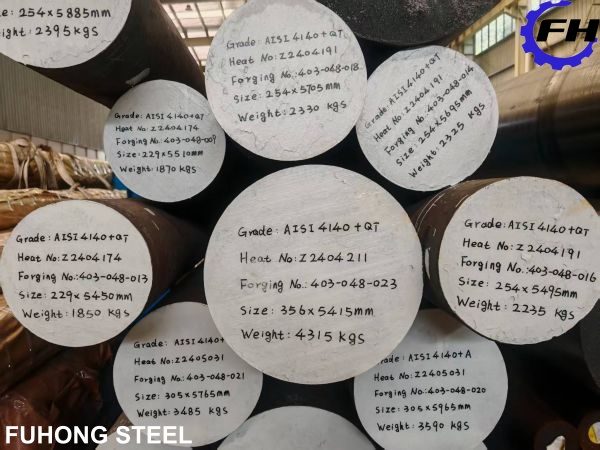
AISI 4140+QT Forged Round bars

AISI 4140 STEEL & EQUIVALENT GRADE CHEMICAL COMPOSITION

GradeCSiMnPSCrMo
41400.38-0.430.15-0.350.75-1.00≤0.035≤0.040.8-1.10.15-0.25
42CrMo0.38-0.450.17-0.370.5-0.8≤0.035≤0.0350.9-1.20.15-0.25
42CrMo40.38-0.45≤0.40.6-0.9≤0.025≤0.0350.9-1.20.15-0.30
SCM4400.38-0.430.15-0.350.6-0.85≤0.035≤0.040.9-1.20.15-0.30
EN190.35-0.450.15-0.350.5-0.8≤0.035≤0.0350.9-1.50.20-0.40

AISI 4140 STEEL PHYSICAL PROPERTY

  • Density: 7.85 g/cm³
  • Melting point: approx. 1425-1475°C
  • Thermal conductivity: approx. 42 W/(m・K) (room temperature)
  • Elastic modulus: approx. 200 GPa
  • Poisson’s ratio: 0.27-0.30

AISI 4140 STEEL FORGING

The core of 4140 steel forging is “temperature control, deformation control, and cooling control”.

To reduce the temperature difference between the inside and outside of 4140 steel and avoid cracks caused by rapid heating, it can be preheated and held at 600℃ and 800℃ in stages.Initial forging temperature should be carried out between 1100℃-1120℃,and final forging temperature shall not be lower than 850°C.

During forging, deformation should be slow, and the microstructure should be improved by multi-directional upsetting and drawing to ensure that the forging ratio is above 4.

After forging, 4140 steel should be cooled as slowly as possible in a furnace or in sand.

AISI 4140 STEEL HEAT TREATMENT

The core advantage of AISI 4140 steel is its excellent heat treatability. Its properties can be adjusted through different processes to meet the needs of various industrial applications.

Typical Heat Treatment Process for AISI 4140 Steel

  • AISI 4140 Steel Normalizing

Normalizing is used to refine the structure of forgings that might have cooled non-uniformly after forged,and considered as a conditioning treatment before final heat treatment.

Normalizing temperature for AISI 4140 steel should be carried out between 870℃-900℃. hold suitable time for the steel to be thoroughly heated to  complete the ferrite to austenite transformation.Finally, air cooling.

After normalizing, AISI 4140 steel can obtain a uniform fine-grained pearlite + ferrite structure with a hardness of HB200~240, which is easy to machine.

  • AISI 4140 Steel Annealing

The full annealing temperature for AISI 4140 steel should be between 800℃ and 850℃, with an appropriate holding time to ensure sufficient heating, followed by slow cooling in the furnace.

After annealing, AISI 4140 steel not only completely eliminates internal stress, but also obtains a spheroidal pearlite structure with a hardness below 229 HB, resulting in better machinability.

Another commonly used process is stress-relief annealing: heating temperature 550~600℃, holding for 2~4 hours, and finally furnace cooling.This treatment process can eliminate more than 80% of the internal stress while maintaining the microstructure and hardness essentially unchanged.

  • AISI 4140 Steel Quenching & Tempering

This is the core heat treatment process for improving the performance of AISI 4140 steel.The key is “quenching + high-temperature tempering,” which ultimately forms a uniform sorbitic structure, achieving an optimal balance of “strength, toughness, and plasticity.”

The quenching temperature for AISI 4140 steel should be between 840℃ and 875℃, and the quenching medium can be water or oil. After quenching, a martensitic structure (quenching core) is obtained, with a hardness reaching 50 HRC.

Tempering is usually performed immediately after quenching to eliminate the stress generated during quenching, but its core purpose is to obtain the desired properties.

AISI 4140 steel can be tempered in the range of 200-650°C as required. Practical experience shows that 4140 steel achieves optimal overall mechanical properties at a tempering temperature of 550-650°C.

AISI 4140+QT Steel Mechanical Property

Tensile Strength Yield StrengthElongationReduction of Area Impact Charpy-V Hardness
850-1000 Mpa≥670Mpa≥13%≥45%≥54J28-34HRC

AISI 4140 STEEL SUPPLY FORM & SIZE & TOLERANCE

If you’re searching for reliable 4140 steel supplier who are based in China, FUHONG is the company you’ve been looking for. We have many years of experience and expertise in 4140 steel processing technology, thus we provide efficient and effective solutions when it comes to the 4140 steel. The professionals accompany every client personally to tailor the solution best for them. Get in touch with us and find out how FUHONG can improve your products.

AISI 4140 steel Supplier,Stockist and Exporter,supplied with Round,Square,Flat,Block,and Shaft etc.

Hot Forged Round bar:Φ80-Φ1000mm

Hot Rolled  Round bar:Φ14-Φ290mm

Hot Forged Square bar: Max Thickness:500mm

Flat bar/Blcoks:Thickness :120-800mm ,Width:120-1500mm

Surface FinishBlack-Forged Black-Rolled Rough Turned   Cold DrawnPeeledPolishedGrinded
Tolerance0/+5mm0/+1mm0/+3mmBest H11Best H9Best H9Best h8

Heat treatment:Quenched and Tempered (+QT), Normalizing (+N), Annealing (+A)
Surface finish:Black / Rough turned / Peeled

FREQUENTLY ASKED QUESTIONS FOR AISI 4140 STEEL

Is AISI 4140 steel suitable for shafts?2026-01-09T12:20:19+08:00

AISI 4140 steel is suitable for shaft parts.

After quenching and tempering, it exhibits excellent strength-toughness balance, good hardenability, and the ability to withstand combined loads such as torsion and bending. It also possesses certain wear resistance and fatigue resistance, meeting the working requirements of medium to heavy-duty shaft components such as gear shafts, drive shafts, and machine tool spindles.

Furthermore, its machinability is controllable, facilitating subsequent turning, milling, grinding, and finishing processes.

What is the difference between 4140 and 4145 steel?2026-01-09T12:15:28+08:00

The 4145 type of steel comes from the same family( Chromium-Molybdenum Series) of the AISI 4140 steel. The very small difference is their percentage of carbon content.AISI 4145 has carbon content with 0.43-0.48%,0.05% higher than AISI 4140 Steel.Due to the slight difference in carbon content, the strength of 4145 steel is slightly higher than that of 4140 steel.

With suitable heat treatment, AISI 4140 and AISI 4145 steel have good comprehensive performance,and are widely used in the oil and gas industry.Learn More

Is AISI 4140 steel easy to weld?2026-01-09T10:55:10+08:00

AISI 4140 steel has moderate weldability and is not classified as a free-welding steel.

4140 steel contains approximately 0.4% carbon and alloying elements such as chromium and molybdenum, resulting in strong hardenability. During the welding cooling process, the heat-affected zone is prone to forming a hard and brittle martensitic structure, which easily leads to welding cracks. Therefore, it is necessary to reduce welding risks through preheating (200~300℃), using low-hydrogen welding electrodes, and timely tempering after welding.

Is AISI 4140 steel easy to machine?2026-01-09T10:36:10+08:00

The AISI 4140 steel bar is available readily machinable especially in annealed condition. The complex shapes will require annealing but simple shapes can be machined smoothly along with a normalizing treatment.

For 4140 steel after quenching and tempering, the hardness increases to 28~34HRC, increasing the difficulty of machining. However, carbide tools can still be used to complete the machining.

Is AISI 4140 steel low alloy steel?2026-01-09T10:27:20+08:00

Relatively to carbon steel,low alloy steel is based on carbon steel,and one or more alloying elements are intentionally added to the steel to improve the properties of steel, such as strength, hardness, toughness, wear resistance, and corrosion resistanc etc.the total amount of alloying elements less than 5%,called low alloy steel.

It is no doubt that AISI 4140 steel is a low-alloy steel that contains chromium, molybdenum and manganese alloy elements.Due to its excellent toughness, wear resistance, impact resistance and high fatigue strength, it is widely used in many industries.

How to find a reliable 4140 steel manufacturer?2026-01-09T09:10:28+08:00

Are you looking for a reliable supplier of 4140 steel products? Look no further, FUHONG will meet all your expectations.

As a professional manufacturer in the specialty steel industry, FUHONG focuses on providing reliable 4140 steel solutions for various industries. We provide every customer with traceable product quality inspection reports and a comprehensive after-sales service system. Contact us today to learn more about our products.Learn More

Can 4140 steel be nitrided?2026-01-08T12:06:45+08:00

4140 steel can be nitrided.

After nitriding, 4140 steel forms a dense nitride layer, increasing the surface hardness to HV800~1000, while maintaining its core toughness. Furthermore, its wear resistance, fatigue resistance, and corrosion resistance are significantly enhanced.

Note: 4140 steel requires quenching and high-temperature tempering before nitriding.

What are the differences between 4140 steel and 4340 steel?2026-01-08T11:31:09+08:00

The core difference between the two lies in the fact that 4340 steel contains a large amount of nickel (1.65-2.0%), while 4140 steel contains no nickel. This leads to a series of differences:

  • Performance: 4340 has significantly better hardenability, strength (ultra-high strength grade), and toughness (especially at low temperatures) than 4140.
  • Applications: 4140 is a general-purpose high-strength material for industrial parts, while 4340 is used for ultra-high strength components operating under harsh conditions.
  • Cost: Due to its nickel content, 4340 has higher raw material and processing costs.Learn More
What are the differences between 4140 steel and 4130 steel?2026-01-08T11:46:32+08:00

Although 4140 steel and 4130 steel both belong to the 41xx series chromium-molybdenum alloy steels under the AISI/SAE system, they still have differences.

  • Core Composition: 4130(Carbon:0.28-0.33%) < 4140(Carbon:0.38-0.43%)
  • Mechanical Properties: 4140+QT has higher strength(850~1080MPa) and hardness (28~32HRC), but slightly lower toughness; while 4130+QT has lower strength (650~800MPa), but better impact toughness and plasticity.
  • Processing Performance: 4130 exhibits superior weldability, cold workability, and machinability; while 4140 has slightly better hardenability and a more significant heat treatment strengthening effect, but poor in welding.
  • Applications: 4130 is suitable for manufacturing structural components requiring welding and medium-strength parts subjected to impact loads (such as pipes and low-pressure vessels); while 4140 is suitable for high-strength parts requiring heat treatment strengthening (such as spindles, gear shafts, high-strength bolts, and crankshafts).

Conclusion: The core difference between 4140 steel and 4130 steel stems from their different carbon contents, leading to significant differences in strength, toughness, processing performance, and applications.Learn More

Go to Top