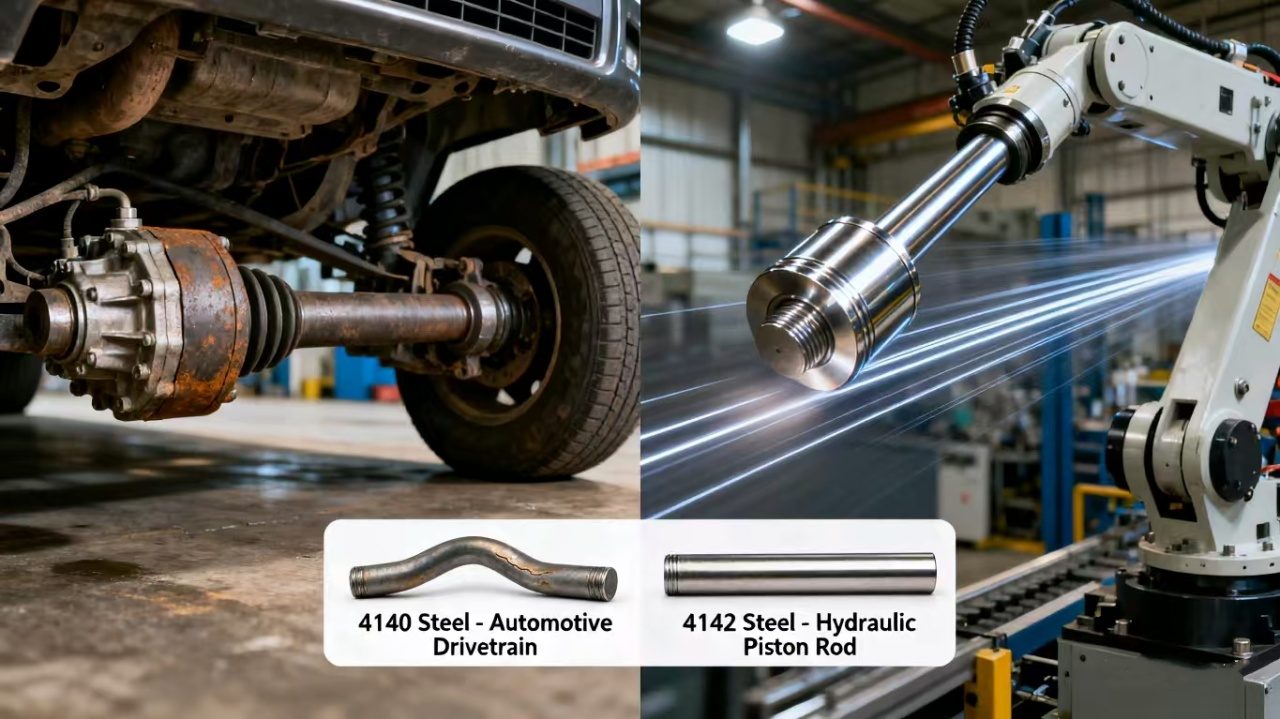
In the field of high-strength alloy structural steels for industrial manufacturing, 4140 and 4142 steels are like twin brothers. Both belong to the Cr-Mo alloy structural steel family, and their excellent hardenability and toughness make them a popular choice for mechanical parts, molds, and shafts.
However, they are not completely identical—a subtle difference in carbon content of 0.02%, like a millimeter’s difference, creates clear distinctions in hardness, wear resistance, and processability, ultimately determining their respective applications in different working conditions. To accurately determine which steel is best suited to your needs, we must first analyze their core differences.
Chemical Composition (Key Difference)
| Element | AISI 4140 | AISI 4142 | Differences |
| Carbon (C) | 0.38 - 0.43% | 0.40 - 0.45% | 0.02% difference! |
| Silicon (Si) | 0.15 - 0.35% | Same | |
| Manganese (Mn) | 0.75 - 1.00% | ||
| Chromium (Cr) | 0.80 - 1.10% | ||
| Molybdenum (Mo) | 0.15 - 0.25% | ||
4140 and 4142 have the same alloying elements, with the essential difference being only 0.02% carbon content. However, this subtle difference leads to a series of subsequent differences in performance and application.
Heat Treatment
The basic heat treatment processes for 4140 and 4142 are the same, with only minor differences in process control due to the slightly higher carbon content of 4142. The key differences are as follows:
- Annealing/Normalizing: Both processes are identical. Annealing is performed at 810-840℃ with furnace cooling (hardness ≤229HBW), and normalizing is performed at 850-880℃ with air cooling. Both processes refine the microstructure and improve machinability.
- Quenching and Tempering (Core Strengthening Process): Quenching is done at 840-860℃ (oil quenching), and tempering is done at 500-650℃ (adjusted according to hardness requirements). At the same tempering temperature, 4142 has a higher final hardness/strength. To achieve the same hardness as 4140, the tempering temperature of 4142 needs to be appropriately increased.
- Quenching Control: 4142 has slightly better hardenability and slightly higher quenching hardness. The risk of cracking during quenching for large/complex parts is slightly higher than that for 4140, requiring more careful selection of quenching media and control of cooling rate.
- Surface Treatment: Carburizing, nitriding, and induction hardening surface strengthening processes are all compatible with each other, with no significant differences.
Mechanical Properties-Quenched and Tempered Condition
Due to its higher carbon content, 4142 steel typically achieves:
- Higher Hardness: Under identical heat treatment conditions (especially tempering temperature), 4142 can achieve higher hardness than 4140.
- Higher Strength: Higher hardness generally translates to higher tensile and yield strengths.
- Slightly Lower Toughness/Ductility: This is the trade-off for higher carbon content and strength. 4142’s impact toughness (e.g., Charpy V-notch impact energy) and reduction of area/elongation are typically slightly lower than those of 4140 of the same hardness grade.
- Higher Wear Resistance: Higher hardness generally results in better wear resistance.
| Typical Property Data Comparison (Quenched at 850℃ + Tempered at 600℃) |
||
| Property | 4140 | 4142 |
| Tensile Strength | 850-1000 MPa | 900-1050 MPa |
| Yield Strength | 750-850 MPa | 800-900 MPa |
| Elongation | 15-25% | 14-22% |
| Reduction of Area | 40-60% | 35-55% |
| Hardness (HBW) | 260-300 | 280-320 |
| Impact,Charpy V | 40-70J | 35-60J |
Machinability & Weldability
In the annealed state, although the hardness of 4142 may be slightly higher than that of 4140, both 4142 and 4140 are relatively easy to machine, with no significant difference. After quenching and tempering, 4142 can achieve a higher hardness, but its machining difficulty increases slightly compared to 4140 steel.
As medium-carbon low-alloy steels, both 4140 and 4142 have unsatisfactory weldability. Due to its higher carbon content, the weldability of 4142 is slightly worse than that of 4140, and the risk of cracking is higher.
Summary: 4140 steel vs. 4142 steel
Essential Differences: 4142 is a slightly higher carbon content (0.40-0.45%) than 4140 (0.38-0.43%).
Performance Differences:
- 4142 steel: Under the same heat treatment conditions, it achieves higher hardness, strength, and wear resistance, but exhibits slightly lower toughness, ductility, and weldability, and is slightly more susceptible to cracking during quenching.
- 4140 steel: Offers improved toughness, ductility, and impact resistance (especially at low temperatures or under impact loads), with slightly better weldability and a relatively lower risk of quench cracking (compared to 4142), and a slightly lower upper limit for strength and hardness.
Application:How to Choose 4140 and 4142 steel?
- Prioritizing toughness/impact resistance? -> Choose 4140. It is the most versatile and widely used medium-carbon chromium-molybdenum steel.
- Prioritizing strength/surface hardness/wear resistance? -> Choose 4142. It excels where higher hardness and wear resistance are required.
- Consider Cost and Availability: 4140 is generally more common, more readily available, and may cost slightly less (though the difference is not significant).
Tips: Think of 4142 as a “high-carbon reinforced version” of 4140. It offers advantages in strength and hardness, but at the expense of toughness and processability . 4140 offers a more balanced option.