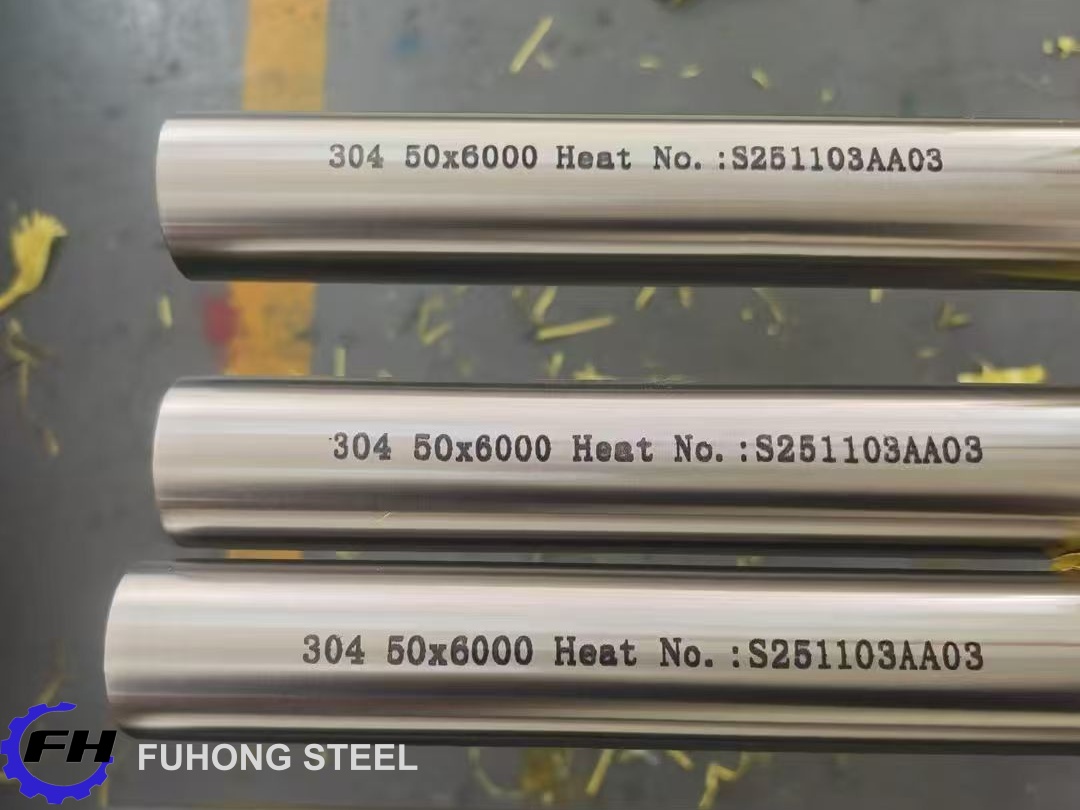
304 stainless steel is a typical representative of austenitic stainless steel under the American ASTM standard, belonging to the 18-8 series (containing 18% chromium and 8% nickel).
With its balanced corrosion resistance, excellent machinability and mechanical properties, and relatively reasonable cost, 304 stainless steel has become an irreplaceable basic material in industrial and civil fields for decades, earning it the reputation of “all-purpose stainless steel” and making it one of the most produced and used stainless steel grades globally.
304 STEEL CHEMICAL COMPOSITION
| Grade | C | Si | Mn | P | S | Cr | Ni |
| 304 | ≤0.08 | ≤1.0 | ≤2.0 | ≤0.045 | ≤0.03 | 18.0-20.0 | 8.0-11.0 |
The “18-8” formula of 304 stainless steel is the cornerstone of its performance:
- Chromium (Cr): ≥18%. A core element, forming an extremely thin and dense chromium oxide film (passivation film) on the surface, giving the steel its “rust-proof” and “corrosion-resistant” properties. This film can self-repair in an oxygen environment if damaged.
- Nickel (Ni): 8-11%. A key element, stabilizing the austenitic structure, giving 304 excellent toughness, ductility, and weldability, and improving corrosion resistance in various environments. Nickel is also a major component of the cost of 304.
- Carbon (C): ≤0.08%. To reduce the risk of chromium carbide precipitation and ensure resistance to intergranular corrosion.
304 STEEL EQUIVALENT GRADE
- China: 06Cr19Ni10/0Cr18Ni9
- Europe:DIN 1.4301/X5CrNi18-10
- Japan: SUS304
304 STEEL PHYSICAL PROPERTY
- Density: 7.93 g/cm³
- Melting point: 1398-1454℃
- Thermal conductivity: 16.2 W/(m·K) (20℃)
- Coefficient of linear expansion: 17.2×10⁻⁶/℃ (20-100℃)
- Resistivity: 72×10⁻⁸ Ω·m
- Magnetic properties: Non-magnetic (solid solution state)
QUICK FAQS FOR 304 STEEL
How corrosion resistant is 304 stainless steel?
Under normal conditions, 304 stainless steel exhibits excellent corrosion resistance to air, fresh water, steam, food, organic compounds, and various chemical media (such as alkalis and weak acids).
However, 304 stainless steel is not “never rust-proof”. In humid, chloride-containing, or heavily polluted (sulfide-containing) environments, it can still rust (usually as surface rust).
How does temperature affect the properties of 304 stainless steel?
- Low-temperature performance: In a liquid nitrogen environment at -196℃, the impact toughness of 304 stainless steel remains above 200 J, making it suitable for cryogenic container applications.
- High temperature performance: 304 steel has good oxidation resistance. Long-term service temperature: ≤800℃, short-term withstand temperature: 870-925℃.
Can 304 stainless steel be hardened by quenching?
No. Due to its stable austenitic structure, 304 stainless steel cannot be martensitic strengthened through traditional quenching processes. (Or rather, the strengthening effect is extremely insignificant and has no practical application value.)
Is 304 steel suitable for cold working?
Due to its excellent plasticity and toughness, 304 steel can be cold-worked by stamping, bending, and stretching, making it suitable for forming complex shapes.
However, 304 steel hardens rapidly during cold working, which is both an advantage (it can improve local strength) and a challenge (it increases the difficulty of subsequent processing and tool wear).
Is 304 stainless steel easy to weld?
304 steel has excellent weldability and can be welded using all standard methods without preheating. However, for optimal corrosion resistance, it is recommended to perform solution treatment after welding (heating to 1050-1100°C followed by rapid cooling) to eliminate carbide precipitation.
304 or 304L, which is better?
The choice between 304 and 304L depends primarily on whether welding is required and the intensity of corrosion in the operating environment.
- Choose 304: No welding required, suitable for ordinary corrosive environments (such as everyday kitchenware and decorative parts), lower cost, and balanced overall performance.
- Choose 304L: Welding required, for long-term use in high-temperature (425-850℃) or highly corrosive environments. Its low carbon content helps prevent intergranular corrosion after welding, resulting in superior corrosion resistance.
304 STEEL HEAT TREATMENT
304 stainless steel is an austenitic stainless steel. The core objective of its heat treatment is to improve corrosion resistance, eliminate residual stress, and restore plasticity, rather than to achieve strengthening through quenching and tempering (austenitic stainless steel does not undergo allotropic transformation and cannot have its hardness increased through heat treatment). The main heat treatment processes for 304 stainless steel include solution treatment and stress-relieving annealing.
304 Steel Core Process: Solution Treatment
Heating Temperature: 1010℃~1150℃. Too low a temperature will result in insufficient carbide dissolution; too high a temperature (above 1150℃) will lead to coarse grains, reducing material strength and toughness.
Holding Time: Determined based on workpiece thickness, generally calculated at 1~2 minutes/mm thickness. For thin plates, the holding time can be shortened to 5~30 minutes, while for thick-walled parts, it can be appropriately extended, but prolonged holding should be avoided to prevent grain coarsening.
Cooling Method: Rapid cooling is essential, with water quenching (water cooling) being the preferred method. Rapid cooling inhibits the redeposition of carbides at grain boundaries, ensuring a good solid solution effect; if air cooling or slow cooling is used, carbides will redeprecipitate, severely reducing corrosion resistance.
Solution treatment allows chromium-carbon compounds (Cr₂₃C₆) precipitated during the smelting or processing of 304 steel to redissolve into the austenitic matrix, ensuring a chromium content of ≥18% in the matrix. This restores and enhances the material’s resistance to intergranular corrosion.
Simultaneously, it homogenizes the chemical composition and microstructure, refines the grain size, eliminates work hardening, and restores the plasticity and toughness of 304 steel, facilitating subsequent cold working (such as deep drawing and stretching).
304 Steel Mechanical Property in Solution Treatment Condition
| Tensile,Mpa | Yield,Mpa | Elongation,% | Reduction of Area,% | Hardness,HBW |
| ≥520 | ≥205 | ≥40 | ≥60 | ≤187 |
As can be seen from the table, 304 steel exhibits excellent plasticity and toughness after solution treatment, but its strength is at a moderate level, making it suitable for subsequent forming processes such as cold stamping, deep drawing, and bending.
304 Steel Stress-Relief Annealing
Primarily used to eliminate residual internal stress generated during cold working (such as bending, stretching, and stamping) or welding, preventing stress corrosion cracking of workpieces in service environments. It also slightly restores material plasticity without altering the matrix structure.
Process Parameters
- Heating Temperature: 250℃~425℃. Temperature must not exceed 450℃, otherwise chromium carbides will precipitate at the grain boundaries, reducing corrosion resistance.
- Holding Time: Determined based on workpiece thickness and stress distribution, generally 1~3 hours.
- Cooling Method: Air cooling is sufficient; rapid cooling is not required.
304 STEEL SUPPLY FORM & SIZE & TOLERANCE
Round bar: Dia 6-400mm
Square bar: Dia 6-200mm
Flat bar:2 x 10-20 x 200mm
Hexagonal bar: Dia 6-150mm
| Surface Finish | Black-Forged | Black-Rolled | Rough Turned | Cold Drawn | Peeled | Polished | Grinded |
| Tolerance | 0/+5mm | 0/+1mm | 0/+3mm | Best H11 | Best H9 | Best H9 | Best h8 |