AISI 416, a martensitic free-machining stainless steel, is made by adding extra sulfur (minimum 0.15%) to 410 stainless steel, which enables it to break chips and lubricate the cutting surface.
With just simple oil quenching and tempering, 416 steel can achieve a hardness of around 38-42 HRC and retain its magnetism in any state.
Therefore, for machined parts requiring high hardness, magnetism, and rapid machining, 416 is often the most economical hardenable stainless steel.
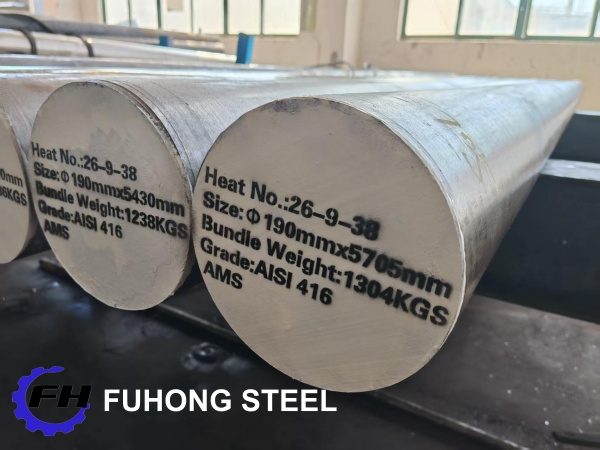
AISI 416 STEEL CHEMICAL COMPOSITION
| Grade | C | Si | Mn | P | S | Cr | Mo |
| 416 | ≤0.15 | ≤1.0 | ≤1.25 | ≤0.06 | ≥0.15 | 12.0-14.0 | / |
| X12CrS13 | 0.06-0.15 | ≤1.0 | ≤1.5 | ≤0.04 | 0.15-0.35 | 12.0-14.0 | ≤0.6 |
AISI 416 STEEL EQUIVALENT GRADE
| Europe | USA | China | Japan |
| X12CrS13/1.4005 | 416 | Y12Cr13 | SUS 416 |
AISI 416 STEEL PHYSICAL PROPERTY
| Density, g/cm3 | 7.75 |
| Melting point,°C | 1480-1530 |
| Thermal conductivity,20℃ W/(m.K) | 25 |
| Modulus of elasticity,Gpa | 200 |
| Coefficient of thermal expansion,µm/(m·K) | 9.9 |
| Magnetic response | Magnetic |
AISI 416 STEEL FORGING
416 stainless steel is a free-machining martensitic stainless steel containing sulfur, which easily produces MnS inclusions (the source of cracks). Therefore, it is strictly forbidden to forge at low temperatures or to rapidly cool after forging, and it is not suitable for severe upsetting and large deformation.
| Preheating | Initial forging temperature | Final forging temperature | Forging ratio |
| 750–800℃ | 1150-1200℃ | 900–930℃ | ≥4:1 |
AISI 416 steel requires slow cooling after forging. Full annealing is recommended.
AISI 416 STEEL HEAT TREATMENT
AISI 416 steel Pretreatment: Softening Annealing
AISI 416 steel is heated to 815–900 °C, held for a sufficient time to allow the cross-section to reach that temperature, and then slowly cooled in the furnace. Annealed 416 steel is soft and most easily machined.
AISI 416+A steel Mechanical property
| Tensile strength Rm | Yield strength Rp0.2 | Elongation A | Reduction of area | Hardness | |
| AISI 416+A | 515–620 MPa | 275–345 MPa | 15–30% | 40–60% | 155–190 HB |
AISI 416 steel Final Heat Treatment: Quenching & Tempering
Austenitize 416 steel at 925–1010 °C . Hold 30–60 minutes, roughly one hour per 25 mm of section, then quench in oil. Air cooling works for thinner sections, but oil is the safer default.
Temper immediately after quenching. Two temperature ranges are suitable:
- 205–370 °C gives 38–42 HRC and the best corrosion resistance 416 steel can offer.
- 595–705 °C gives 24–30 HRC with significantly improved toughness.
Avoid 425–540 °C. Hardness is still high in that band, but impact toughness drops, so parts can fail without much warning. Air cool after tempering.
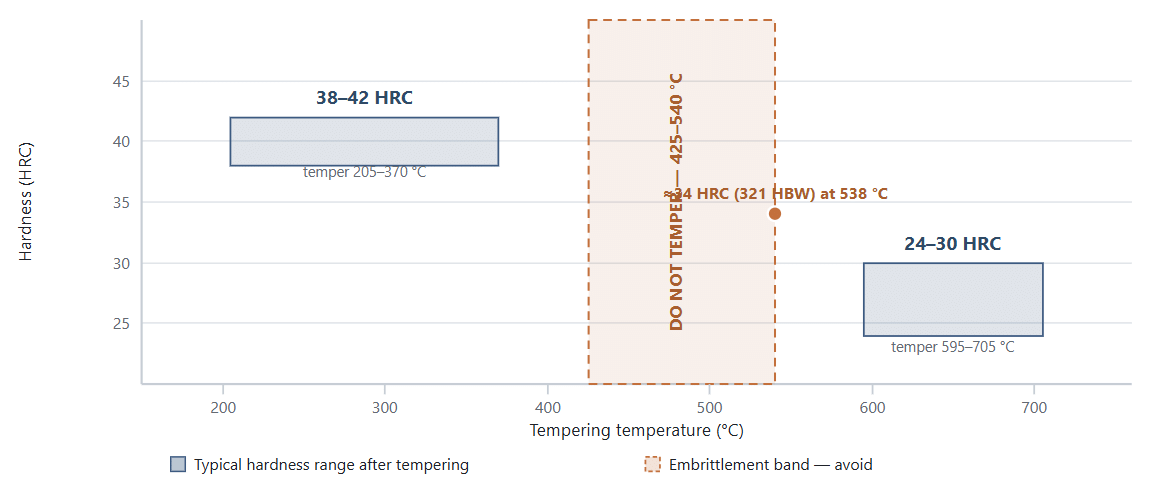
Typical hardness of 416 after hardening (≈980 °C, oil quench) and tempering.Hardness falls as the tempering temperature rises. The 425–540 °C band keeps hardness up but drops impact toughness, so it is avoided.
AISI 416+QT steel Mechanical property
| Tempering | Tensile strength Rm | Yield strength Rp0.2 | Elongation A | Hardness |
| 205 °C | ≈1310 MPa (190 ksi) | ≈1000 MPa (145 ksi) | 12–15% | 38–42 HRC |
| 538 °C | ≈1000 MPa (145 ksi) | ≈795 MPa (115 ksi) | 13% | 321 HBW |
| 595–705 °C | — | — | — | 24–30 HRC |
AISI 416 STEEL SUPPLY FORM & SIZE & TOLERANCE
Round bar: Dia 6-400mm
Square bar: Dia 6-200mm
Flat bar:2 x 10-20 x 200mm
Hexagonal bar: Dia 6-150mm
| Surface Finish | Black-Forged | Black-Rolled | Rough Turned | Cold Drawn | Peeled | Polished | Grinded |
| Tolerance | 0/+5mm | 0/+1mm | 0/+3mm | Best H11 | Best H9 | Best H9 | Best h8 |
Heat treatment Supply Conditions
| Condition | Hardness | What it is for |
| A, annealed | ≈155–190 HB | machine first, harden and temper after |
| T, intermediate temper | 26–32 HRC | machine and use as-is, common for shafts |
| H, hard temper | 35–42 HRC | used where hardness is needed without further treatment |
Get reliable 416 steel for your upcoming Applications
√ ISO 9001 Certified √ MTR Included √ Global Shipping √ Custom Cutting √ Technical Support